
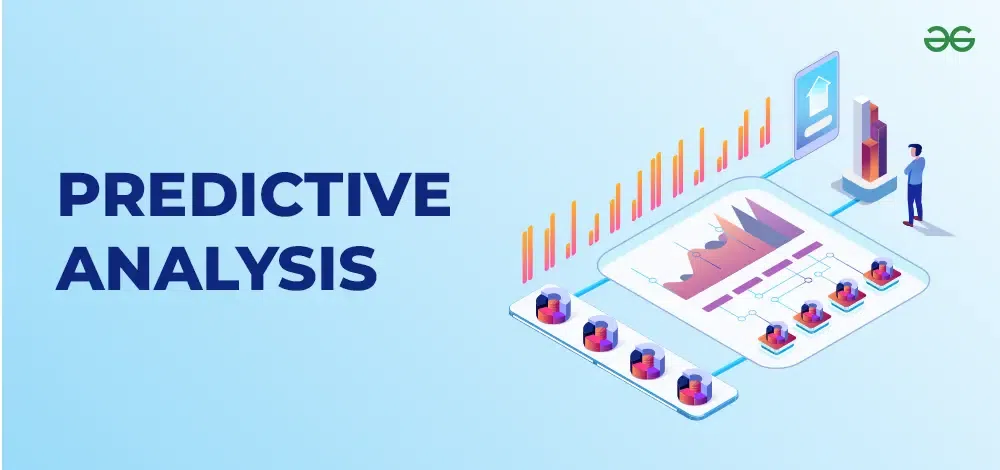
Businesses are no longer depending only on past performance or intuition when making decisions in the fast-paced digital economy of today. Rather, they’re focusing on the future, use predictive analytics to predict trends, foresee customer needs, and make strategic decisions that help them stay ahead of the competition.
What is Predictive Analytics?
According to Harvard Business School, “Predictive Analytics is the use of data to predict future trends and events. It uses historical data to forecast potential scenarios that can help drive strategic decisions.”
According to research by Lim, et al., (2023), “Predictive analysis is a type of analysis that makes use of different techniques for efficient and accurate predictions. This helps to improve the future outcomes leading to overall performance improvement.”
Simply put, the practice of forecasting future events using statistical models, machine learning algorithms, and historical data is known as predictive analytics. Finding patterns in the available data to create incredibly precise forecasts is the goal, not speculating.
Why It Matters?
Predicting what’s coming next is an enormous competitive advantage in a world where markets change fast, customer demands change rapidly, and competition is strong worldwide. Companies that use predictive analytics are able to:
1. Identify Trends Early.
Businesses can detect trends and emerging issues early by evaluating and responding to real-time operational and customer data. This allows for proactive measures to be taken before customer relations deteriorate. By analyzing sales data, seasonal trends, and outside variables, AI-driven predictive analytics has, for instance, predicted product demand in the retail industry, minimizing stockouts, cutting expenses, and improving customer happiness through prompt inventory availability [Referred: Okeleke, et al., (2024)]
2.Reduce Risks.
By using predictive analytics, industries like healthcare providers may better control demand and fluctuation, lowering the possibility of overcrowding or resource shortages. In contrast to average-based planning, healthcare researchers employed linked predictive and prescriptive models (via Classification and Regression Trees, or CART) to more effectively plan hospital personnel and ward occupancy [Bandi, et a., 2024].
3. Optimize Operations.
Predictive analytics for demand forecasting assist companies ensure that the right products are available when they’re needed, which significantly increases productivity and reduces expenses.
Fun Fact: A clothing retailer used predictive analytics and reduced 6% of lost sales—by predicting inventory needs and aligning stock ahead of time.
4. Deliver Personalized Customer Experiences.
By customizing content, offers, and timing to each user’s interests and behavior, predictive analytics change customer engagement from generic communications to hyper-personalized encounters. 80% of customers are more likely to do business with a company that provides tailored experiences, per a study by Epsilon . Additionally, according to the survey conducted by Determ, 86% of marketers saw a discernible improvement in business outcomes as a result of their customized campaigns.
Real World Applications of Predictive Analytics.
1. Amazon
By using predictive analytics to provide incredibly efficient and personalized shopping experiences, Amazon maintains its lead in the competitive e-commerce industry. Item-to-item collaborative filtering, which emphasizes relationships between products rather than merely customer profiles, is the foundation of its methodology. For instance, when a customer purchases a smartphone, Amazon’s technology suggests complementary products, such as cases or chargers, depending on what other smartphone customers have already bought. Advanced algorithms like the Nearest Neighbors approach, which examines user reviews, browsing habits, and frequency of purchases to find product similarities, enable this process.
To provide timely, strategic recommendations, Amazon uses deep learning techniques such as Recurrent Neural Networks (RNNs) in addition to collaborative filtering (Medium). These approaches follow the order in which users search for things or add products to their basket. Its recommendation engine is further refined by Big Data gathered during browsing, which includes information like reviewed items, shipping address (to predict factors like income level), and review activity. By using this data to create a 360-degree consumer profile, Amazon is able to categorize customers into certain niches and recommend goods that people with comparable profiles have liked.
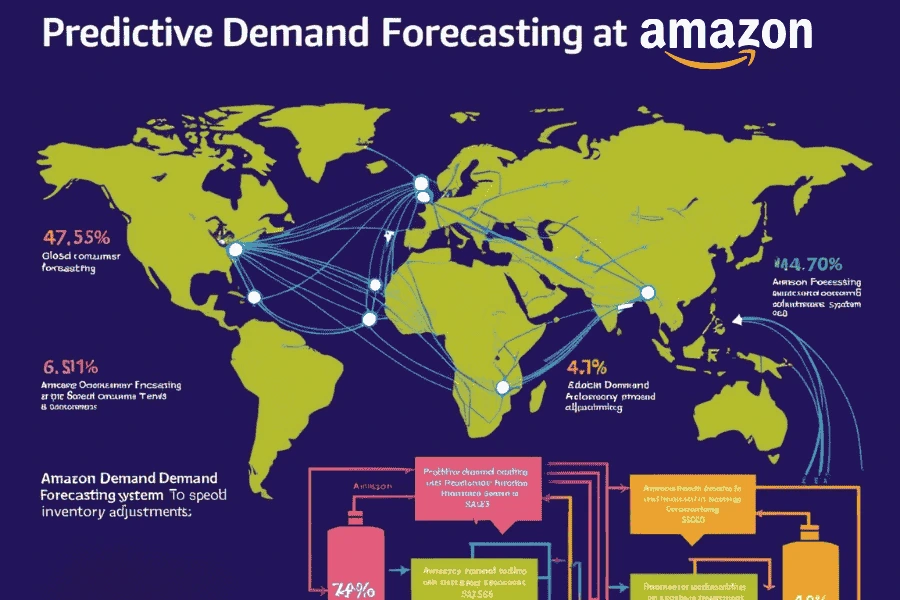
Initiatives like anticipatory shipping, which strategically moves goods closer to customers before they place an order to reduce delivery times, are also supported by predictive analytics. Amazon also uses sophisticated machine learning algorithms and AI-driven demand forecasts to improve supply chains, cut waste, and match inventory to changing customer preferences. Amazon maintains its position as the industry leader in e-commerce by leveraging a combination of advanced algorithms, real-time behavioral data, and predictive demand forecasts to increase sales and cultivate enduring customer loyalty.
2. Netflix
Over 80% of viewer activity is driven by Netflix’s incredibly advanced predictive analytics engine accoriding to a case study, which powers its supremacy in the streaming market. According to Linkedin, Netflix saves more than US $1 billion annually in customer acquisition expenditures because to its recommendation engine, the Netflix Recommendation Engine (NRE), which sorts thousands of titles through more than a thousand unique clusters to customize content for every user.
Basic matching is merely one aspect of this approach. To provide a highly customized and captivating experience, it continuously consumes contextual cues like the time, device, and location, as well as comprehensive behavioral data—what users watch, search, click, pause, scroll, or even revisit.
Analytics are used to improve even the visual display. As an illustration, Netflix adjusted thumbnails for a particular episode, resulting in an 18% increase in completion rates. This shows how data-driven interface adjustments greatly increase user engagement.
The renowned Netflix Prize, which gave $1 million to teams whose algorithms could improve upon Netflix’s current recommendation engine by 10% in predicted accuracy, marked the beginning of the company’s significant efforts in predictive modeling. The result showed an 8.43% improvement, but because of the engineering complexity and Netflix’s shift to streaming, the winning approach was not fully implemented [Source: Wired.com].
In addition to personalization, Netflix integrates analytics into its operations, content, and product. The full integration of data scientists into marketing, production, and creative teams enables them to leverage analytics at scale, from influencing the selection of original series to customizing artwork, trailers, and even production timelines.
3. Uber
Uber’s competitive advantage stems from the deep integration of predictive analytics, which is fueled by innovative algorithms and real-time systems. Uber’s commission, or “take rate,” increased from about 25% to 29% on average since implementing “dynamic pricing” in 2023, according to a University of Oxford research that examined 1.5 million UK journeys from 258 drivers. On higher-value rides, it occasionally surpassed 50%. Drivers’ real hourly wages decreased from over £22 before operating costs to just over £19 after accounting for inflation as a result of these changes, and they also spent more time waiting for employment without getting paid.
A more general algorithmic change is reflected in this dynamic pricing approach. According to a distinct academic study from Columbia Business School, Uber’s “upfront pricing” strategy, which was implemented in 2022, increased the take rate from 32% to 42%, with some trips surpassing 50%. This helped the company generate a profit. Notably, this adjustment enabled the business to report its first yearly profit in 2023. By the end of 2024, Uber had recovered a $303 million loss in 2022 and had $6.9 billion in cash on hand [Sources: Business Insider and The Guardian].
These analytics initiatives were still supported on the backend by Uber’s Michelangelo platform, which is its machine learning infrastructure. According to Uber, Michelangelo serves approximately 400 ongoing machine learning projects, completes more than 20,000 model training tasks each month, and keeps over 5,000 models in production, with peak performance achieving up to 10 million real-time predictions per second. Important functions including ETA forecasting, fraud detection, driver-rider matching, and pricing computation are powered by these models.
Uber’s predictive powers have essentially been greatly enhanced: despite the volatility of driver earnings, the company’s fare take rate and profitability have increased due to its dynamic pricing and upfront pricing methods. All of this is powered by Michelangelo, a highly scalable machine learning platform that allows for real-time decision-making throughout the system.
4. Starbucks
Through the analysis of data from sources such as point-of-sale systems, mobile app behavior, IoT-equipped espresso machines, and environmental contexts like weather and local events, Starbucks’ Deep Brew platform serves as the foundation for its predictive analytics strategy, revolutionizing operational efficiency, customer engagement, and innovation. This makes hyper-personalization possible: the platform customizes specials and recommendations not just based on a customer’s past purchases but also on the time of day, the weather, the amount of inventory, and general community trends. According to Klover, compared to earlier marketing strategies, AI expenditures yielded a 30% return on investment and a 15% increase in customer engagement, demonstrating how dynamic digital signage and predictive promotions significantly increase spending and loyalty.
Operationally, Deep Brew drives inventory and labor optimization. Utilizing demand projections that account for past sales, local events, weather variations, and inventory availability, it automates restocking decisions, reducing waste and guaranteeing in-stock availability. For example, according to Klover, an AI-powered supply chain system (such as Deep Brew) can generate up to US$125 million in benefits annually, which include $15 million in sustainability gains, $40 million in direct cost reductions, and $50 million in lost revenue. Furthermore, according to Sisense, IoT sensors built into espresso machines record machine usage data, sometimes producing over 5 megabytes per shift. This data enables Deep Brew to carry out predictive maintenance, which minimizes downtime and maintains customer satisfaction and service consistency.
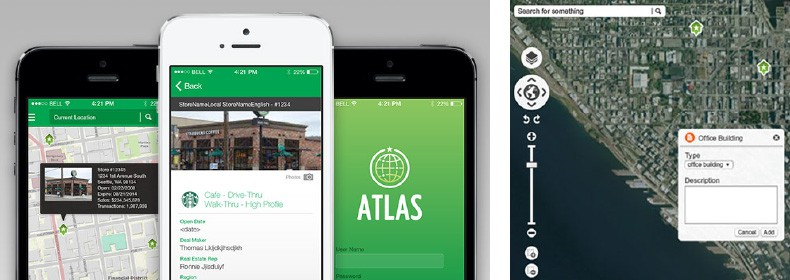
Starbucks uses data for strategic planning in addition to operations and personalization. Its unique tool, “Atlas,” forecasts the profitability of possible new store sites using geographic data from app users, including demographics, traffic flow, local income levels, and anonymized geolocation. By reducing the financial risk associated with underperforming websites, this strategy makes sure that every new store is set up for success.
Collectively, Starbucks’ use of Deep Brew and predictive analytics allows for “humanized automation,” which frees baristas from repetitive duties like inventory counting and equipment monitoring so they can concentrate on interacting with customers. In addition to increasing profits, this dual strategy of improving customer experiences on the front lines and boosting efficiency behind the scenes strengthens Starbucks’ reputation as a technologically sophisticated and hospitable company.
5. Sri Lankan Airlines
Predictive analytics has been meticulously incorporated into SriLankan Airlines’ operations to boost productivity, maximize profits, and enhance customer satisfaction. Its collaboration with PROS, a pioneer in AI-powered revenue management systems, is one noteworthy example. SriLankan Airlines has improved its pricing strategy by integrating PROS’ cloud-based tools, which allow for more precise demand forecasting and dynamic pricing adjustments. Profitability has increased as a result of this strategy’s higher load factors and improved capacity matching market demand.
To improve flight schedules and itineraries, the airline has also implemented innovative flight planning techniques like the Lido Flight Planning System. With the use of predictive models, these technologies evaluate a number of variables, such as air traffic and weather patterns, enabling more effective route planning and lower fuel use. These systems’ integration has increased on-time performance and reduced operating costs significantly.
To improve fleet reliability, SriLankan Airlines has also made investments in predictive maintenance technologies. The airline can predict possible equipment problems before they happen by examining real-time sensor data and maintenance history. Because to this proactive strategy, there are now fewer unplanned maintenance incidents, which reduces downtime and increases fleet availability overall.
Through these programs, SriLankan Airlines shows how operational excellence and competitive advantage in the aviation sector may be achieved through the strategic application of predictive analytics.
Final Thought:
Predictive analytics isn’t just about numbers—it’s about foresight, agility, and smarter decisions. Businesses that harness its power don’t wait for the future to happen—they anticipate it, adapt to it, and even shape it. Whether it’s delighting customers with personalized experiences, optimizing operations, or boosting profitability, predictive analytics gives companies the confidence to stay one step ahead in an ever-changing world. The question isn’t whether to adopt it—it’s how fast you can put it to work.
Stay ahead of the curve—embrace predictive analytics today, and don’t forget to subscribe and follow for more insights on how data is shaping the future of business!
Connect with us on;
Facebook
Twitter
Instagram
Linkedin
Recommeded Reading:
1. Predictive Analytics: The Power to Predict Who Will Click, Buy, Lie, or Die – Eric Siegel: An accessible guide to predictive analytics with real-world business examples.
2. Data Science for Business – Foster Provost & Tom Fawcett: Explains how predictive modeling and analytics drive smarter business decisions.
3. Harvard Business Review – Competing on Analytics: Discusses the strategic advantage of embedding analytics into business operations.
4. McKinsey & Company – The Age of Analytics: Explores the impact of data-driven strategies on global businesses.
5. Epsilon – The Power of Personalization: Real-world applications of predictive analytics in e-commerce and recommendation systems.