
Technology is no more merely a business support system in today’s fast-paced world; rather, it is a key factor in innovation, growth, and competitiveness. The relationship between technology and business is growing more significant, vital, and revolutionary than ever.

Staying ahead of the competition requires knowing how technology drives business success, whether you’re a corporate leader, startup founder, or business and innovation student.
Here is how technology is accelerating business success:
01. Artificial Intelligence Powered Decision Making.
Businesses’ usage of artificial intelligence is increasing frequently to foresee trends, analyze data in real time, and make quicker, more informed decisions.
According to a 2022 McKinsey survey, 63% of participants said that business units using AI for decision-making saw a gain in revenue. This represents a significant increase from 22% in 2020.
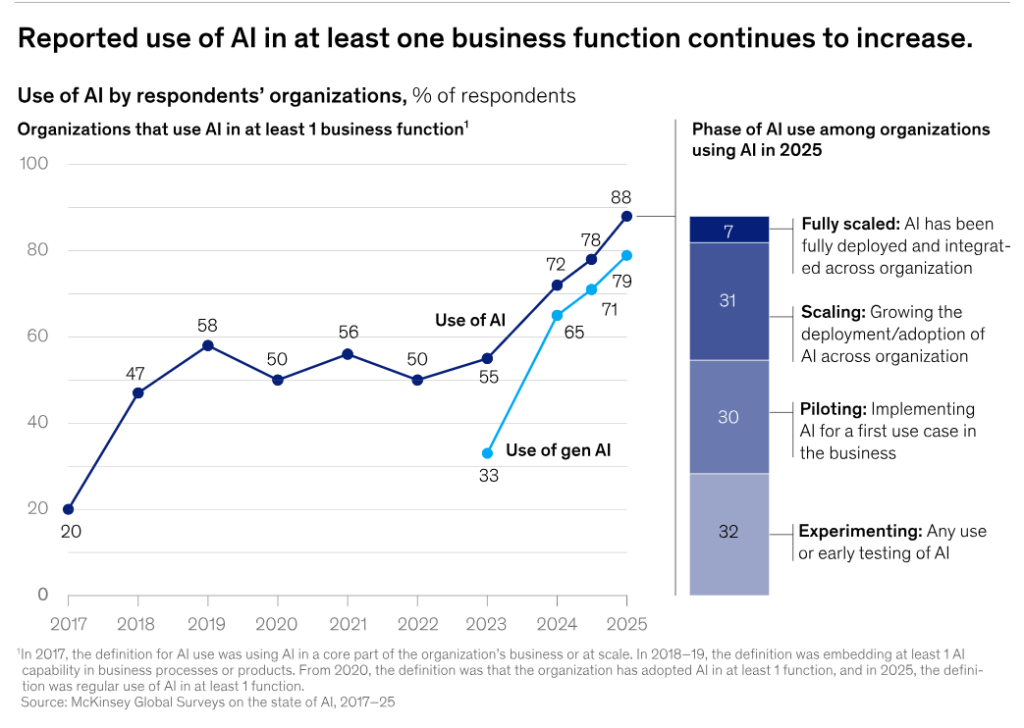
By 2024, 78% of businesses said they were utilizing AI in some capacity, most frequently in marketing and sales, IT, and service operations. Notably, within just six months, the use of AI in the IT department alone increased from 27% to 36%.
As more businesses expand AI use across multiple areas, the impact on efficiency, personalization, and cost reduction continues to grow.
Finally, AI is used by major retailers like Amazon, Walmart, and Zara to forecast consumer preferences, maximize inventory, and cut down on waste. To increase sales, enhance consumer satisfaction, and make strategic supply chain decisions for their worldwide operations, H&M and Sephora use AI to monitor trends, customize items, and automate restocking.
02. Cloud Computing and Remote Access.
Businesses can currently grow digital projects with customized solutions due to cloud platforms that are getting increasingly industry-specific. By 2029, over 50% of companies will use industry cloud platforms to boost corporate expansion, predicts Gartner. A research by Castro (2022) also reveals that the emergence of hybrid work models is also greatly aided by cloud computing, which provides safe, scalable, and easily accessible technologies for communication, data storage, and teamwork.
Without depending on costly infrastructure, cloud-based technologies enable remote teams, lower IT costs, and enable rapid scaling for startups and small organizations. As an example, By utilizing AWS cloud infrastructure, the cloud-native business Canva was able to grow to over 150 million users worldwide without the need for expensive physical systems. Its cloud-based concept permitted a cross-border hybrid workforce and allowed for smooth cooperation. According to the 2024 AWS update and Canva, this strategy allowed remote teams retain a 95% employee retention rate while lowering operating costs.
03. Digital Customer Experiences.
Customers want seamless, customized digital experiences by 2025. Companies that use automation software, e-commerce technologies, and Customer Relationship Management (CRM) platforms are better equipped to satisfy these demands. According to a research by Nethanani, et al., (2024) reveals that CRM adoption by itself has been demonstrated to boost sales by 15–30% and improve customer retention by 25–40% among SMEs. Due to process automation and improved data management, these systems also increase operational efficiency by 20–35%. Strong managerial support, system customization, and efficient user training are frequently linked to successful CRM adoption. These factors all assist organizations increase online conversions and customer retention.
Moreover, customer experiences and general productivity can be significantly enhanced by even simple chatbots or automated email workflows. Key findings from the literature demonstrate that chatbots with AI capabilities successfully lower response times and operating expenses while increasing customer satisfaction. Up to 70% of ordinary customer inquiries can be handled by chatbots, according to research by Uzoka, et al., (2024), freeing up human agents to undertake more difficult jobs.
04. Cybersecurity as a Business Enabler.
Cybersecurity has become an essential company responsibility as digital activities expand. As revealed by World Economic Forum (2025), protecting digital assets is crucial, as 54% of large enterprises consider supply chain vulnerabilities to be a key risk, and over 60% of organizations modify their cybersecurity strategy in reaction to geopolitical concerns. Given that one in three CEOs now rank cyber espionage and intellectual property theft as their top concerns businesses that place a high priority on data protection and cultivate digital trust are not only guaranteeing company continuity but also winning consumer loyalty and lowering legal and operational risks.
Cybersecurity is evolving as a differentiator in the marketplace. 85% of customers said they will not conduct business with a company they believe to be unsecure, according to Forbes. Additionally, according to Gitnux Market Data, 67% of businesses that enhance cybersecurity report quantifiable improvements in customer satisfaction, and 78% of consumers want cybersecurity to be a part of their overall customer experience. These statistics demonstrate that in addition to protecting operations, a robust cybersecurity approach increases brand trust, fosters customer loyalty, and provides a definite competitive edge.
05. Automation and Smart Operations.

Businesses are revolutionizing operations by automating repetitive jobs, decreasing manual labor, and accelerating processes through the use of technologies like Robotic Process Automation (RPA) and the Internet of Things (IoT). While IoT allows real-time inventory tracking, automated billing, scheduling, and smarter supply chain decisions, RPA increases productivity by 30–70% and reduces labor expenses by up to 50% (referred from PMC & SpringerLink), making these systems indispensable across industries.
🧠 Final Thoughts
Technology is no longer optional — it’s the engine of modern business growth. In future, the businesses that embrace innovation, adapt to digital trends, and invest in the right tech tools will lead the way.
Whether you’re starting a business, running one, or studying the connection between business and tech (like I am), one thing is clear:
In 2025 and beyond, business means tech.
✅ Let’s Discuss:
What technologies are shaping your business or ideas?
Share your thoughts in the comments or connect with me on:
📸 Instagram
🔗 LinkedIn
📩 Want more insights like this? Subscribe and never miss a post.