

Abstract
This conceptual study addresses a critical theoretical gap in the literature on business data analytics (BDA) adoption by small and medium-sized enterprises (SMEs), particularly within developing economy contexts such as Sri Lanka. Existing analytics adoption research remains largely dominated by technology-centric and developed-country perspectives, often overlooking the contextual, organizational, and managerial realities that shape adoption decisions in resource-constrained SMEs. To address this gap, the study proposes a theoretically integrated conceptual framework that reconceptualizes BDA adoption as a dynamic capability-building process rather than a one-time technological decision. Drawing on the Technology–Organization–Environment (TOE) framework, Diffusion of Innovation (DOI) theory, the Resource-Based View (RBV), and the Technology Acceptance Model (TAM), the framework highlights the interaction between technological readiness, organizational resources, environmental pressures, and managerial and human capabilities. Central to the framework is the role of managerial cognition and analytics literacy as enabling mechanisms through which structural factors influence adoption outcomes. The study contributes theoretically by extending analytics adoption theory to better reflect SME-specific and developing-economy conditions, advancing SME literature by emphasizing owner-manager dominance and informal decision-making structures, and offering a context-sensitive yet transferable model for emerging markets. The framework provides a foundation for future empirical research and offers practical insights for SME owners, policymakers, and technology providers seeking to promote sustainable and effective analytics adoption.
Keywords: Business Data Analytics; SME Technology Adoption; Conceptual Framework; Developing Economies; Managerial Capability
1. Introduction
1.1 Background of the Study
1.1.1 Global Significance of Business Data Analytics.
Corporate data analytics has become a crucial strategic competence in the contemporary global business landscape. The methodical application of statistical and computational tools to extract valuable insights from gathered data is known as data analytics, which helps businesses make better decisions, increase productivity, and gain a competitive edge (Iqbal , et al., 2020). By converting unprocessed data into useful insights that improve performance and responsiveness to market conditions, analytics facilitates evidence-based decision-making. Beyond improving operational efficiency, analytics helps businesses predict future trends, streamline operations, and promote creativity in fields including supply chain management, marketing, and customer behaviour analysis (Ghodake , et al., 2024). As the volume, variety, and velocity of corporate data have increased in recent years, the significance of analytical capabilities has grown rapidly, changing how organizations manage operations and develop strategy.
Despite this global trend, the adoption of data analytics is uneven across firms of different sizes. While smaller businesses frequently lag behind due to resource limitations and poor technical skills, large multinational enterprises frequently use analytics to encourage innovation and preserve competitive advantage. Small and medium-sized businesses (SMEs), which are under increasing pressure to implement digital technology in order to stay competitive in marketplaces, are particularly affected by this discrepancy. The ability of SMEs to extract value from data, therefore, plays a significant role in determining their survival and growth prospects in the digital economy.
1.1.2 Role of SMEs in Economic Development.
Globally, SMEs are universally acknowledged as essential drivers of economic expansion, employment generation, wealth development, and socioeconomic inclusion. The Organization for Economic Cooperation and Development (OECD) reports that SMEs constitute around 99% of all enterprises in the OECD region, provide 50–60% of value added on average, and are the majority of employers (OECD, 2022). According to World Bank estimates, SMEs account for over 50% of all employment and 90% of all enterprises worldwide (World Bank, 2025), highlighting their crucial significance in both developed and developing economies.
By encouraging local entrepreneurship, broadening economic activity, and fostering innovation through adaptability to customer demands, SMEs provide economic resilience (OECD, 2022). SMEs play an integral role that goes beyond simple economic production; in many nations, they foster inclusive growth, support local industrial ecosystems, and serve as incubators for entrepreneurial talent. Despite their enormous potential, SMEs frequently have structural disadvantages over larger businesses, such as poor infrastructure, restricted access to capital, and a lack of skilled workers, all of which can limit their ability to invest in technology-driven strategies like data analytics.
1.1.3 Challenges Faced by SMEs in Analytics Adoption.
SMEs typically exhibit lower adoption rates than bigger organizations, despite the widespread acknowledgment of the strategic significance of data analytics. A number of internal and external factors, including inadequate funding, a lack of technical expertise, organizational inertia, and a lack of knowledge about the advantages of sophisticated analytics tools, contribute to this discrepancy. Nearly 40% of SMEs cite a lack of digital and analytical skills as a significant obstacle to implementing modern data-driven technology (OECD, 2021). Limited digital infrastructure, a lack of internal expertise capable of utilizing analytics tools, and a reluctance to invest in new technologies with uncertain returns are examples of internal restrictions.
External issues including insufficient government assistance, limited digital literacy among small business owners, and competitive pressures that put short-term operational survival ahead of long-term technical investment worsen these problems. Evidence from the World Bank Enterprise Surveys, which cover businesses in 119 developing economies, consistently shows that the biggest challenge facing SMEs is limited access to financing, with high borrowing costs and a lack of advisory or consultant support limiting investment in modern digital technologies like analytics (Wang, 2016). According to the OECD, the availability of skills, management quality, and supporting infrastructure all have a significant impact on the uptake of modern techniques like data analytics; without these factors, adoption among SMEs is consistently low (Bianchini & Michalkova, 2019). As a result, even while analytics has a great deal of potential to improve operational performance and competitive positioning, its successful use is nonetheless limited by contextual factors that are especially severe in settings with limited resources.
1.1.4 Contextual Relevance of Sri Lankan SMEs.
The cornerstone of Sri Lanka’s economy, small and medium-sized enterprises (SMEs) are crucial to its economic prosperity. SMEs constitute over 75% of all businesses, provide about 52% of the GDP, and generate approximately 45 % of the employment in Sri Lanka, according to official estimates referenced in national policy debate (The Sunday Times, 2024). These figures demonstrate the sector’s importance in generating revenue, employment, and regional economic dispersion, especially in context of the SMEs’ extensive geographic dispersion among all administrative districts.
With a significant proportion of businesses operating outside of official regulatory frameworks, the development of SMEs in Sri Lanka has mostly happened through informal channels. Many SMEs are still not registered with government agencies, which limits their access to structured capacity-building programs, institutional financing, and technology support. The industry is mostly focused on agriculture and agro-processing, although it also engages in light engineering, services, retail commerce, fisheries, and small-scale manufacturing. The labor-intensive and resource-dependent nature of Sri Lankan SMEs is reflected in their structural composition, which further influences their managerial and technological capacities.
Despite making a significant economic contribution, Sri Lankan SMEs perform worse than their Southeast Asian counterparts, especially when it comes to productivity growth, export involvement, and innovation capacity (The Sunday Times, 2024). The estimated 45% of SMEs fail due to a lack of managerial skills, strategic planning, and entrepreneurial spirit in addition to financial limitations (Jayasekara, et al., 2020). Since analytics-driven decision-making has the ability to address enduring deficiencies in planning, market understanding, and operational control, these structural shortcomings underscore the need of analyzing corporate data analytics adoption. However, Sri Lankan SMEs’ use of contemporary digital technologies like business data analytics is still restricted, mostly as a result of low awareness and insufficient technical preparedness. Studies on comparable technologies like business intelligence show that organizational resources, technological complexity, competitive pressure, and managerial IT competence strongly influence adoption decisions, notwithstanding a shortage of empirical data on analytics adoption (Herath, 2024). With implications for improving long-term sustainability and competitiveness, these contextual elements collectively highlight the need for a conceptual framework that methodically encompasses both enabling and impeding aspects driving business data analytics adoption in Sri Lankan SMEs.
1.1.5 Research Problem
The adoption of business data analytics by small and medium-sized firms (SMEs) is still inconsistent and theoretically unexplained, especially in emerging economy contexts, despite its increasing global dissemination as a strategic capacity. Nearly 40% of SMEs identify a lack of digital and analytical skills as a major obstacle to implementing the latest data-driven technology (OECD, 2021; OECD, 2022). Structural limitations pertaining to management capacity and infrastructure also hinder adoption. Despite the fact that SMEs account for over 50% of global employment and 90% of global firms (World Bank, 2025), the majority of analytics adoption frameworks presently in use are taken from large-firm or developed-economy contexts.
This theoretical gap is especially noticeable in Sri Lanka, where SMEs account for more than 75% of businesses, generate over 52% of GDP, and generate about 45% of employment (The Sunday Times, 2024). Despite their economic importance, Sri Lankan SMEs exhibit relatively low productivity, capacity for innovation, and technological readiness; failure rates are estimated to be around 45%, with deficiencies in managerial skills and strategic planning being the main causes (Jayasekara, et al., 2020). There is currently no comprehensive conceptual framework that methodically explains how technological, organizational, environmental, and human factors jointly shape business data analytics adoption in Sri Lankan SMEs, despite earlier research highlighting factors like organizational resources and managerial IT competence influencing technology adoption (Herath, 2024). The primary research problem of this conceptual study is filling this gap.
1.2 Aim and Objectives of the Study
1.2.1 Study Aim
This conceptual paper’s primary aim is to create an integrated theoretical framework that explains the factors shaping business data analytics adoption among Sri Lankan SMEs. The study aims to identify and organize the important technological, organizational, environmental, and human factors influencing analytics adoption within the particular structural and institutional context of Sri Lankan SMEs by synthesizing insights from established technology adoption theories and prior empirical evidence. The framework attempts to offer a cogent theoretical basis for comprehending adoption behavior in developing-economy environments with limited resources.
1.2.2 Study Objectives
- The following research questions serve as the basis for this conceptual inquiry:
- What crucial elements affect Sri Lankan SMEs’ adoption of business data analytics?
- How do organizational capabilities, leadership skills, environmental forces, and technology readiness combine to influence analytics adoption decisions?
- How can differences in analytics adoption among Sri Lankan SMEs be explained by an integrated conceptual framework?
1.3 Significance of the Study
1.3.1 Theoretical Significance
By focusing on business data analytics in the context of SMEs—a field of study where there is still a dearth of literature—this work advances the theoretical understanding of technology adoption. Despite growing interest in analytics adoption, systematic reviews show that most studies either apply general information systems frameworks or concentrate on larger firms without integrating multiple theoretical perspectives like Diffusion of Innovation (DOI) and TOE (Technology–Organization–Environment), which are frequently used to explain technology uptake in small firms ( Alsulami , et al., 2024). This study advances theory by filling in the gaps between adoption determinants and contextual specificity by combining both frameworks to create an integrated conceptual model suited to Sri Lankan SMEs.
1.3.2 Practical Relevance for SMEs
The suggested approach helps managers and owners of SMEs identify the key organizational, technological, and external variables influencing the adoption of analytics. The relevance of structured frameworks for decision support is highlighted by prior empirical research conducted in Sri Lanka, which reveals organizational resources, competitive pressure, and managerial IT competence as major factors of technology acceptance (Herath, 2024). Thus, the insights help with focused efforts to create capability and prepare for technology.
1.3.3 Contribution to Developing Economy Literature
This study expands digital transformation research beyond developed contexts by grounding the concept in an emerging economy setting. This provides a basis for future comparative and empirical work in similar markets with resource limitations and distinct regulatory regimes.
2. Theoretical Framework
2.1 Literature Review and Theory
2.1.1 Business Data Analytics Literature
The ability to systematically transform massive amounts of structured and unstructured data into actionable insights that support strategic and operational decision-making has made business data analytics (BDA) a fundamental organizational skill in modern businesses. According to recent research, BDA is a socio-technical competence that integrates data, analytical methods, human abilities, and organizational procedures rather than just a set of technological tools (Wamba, et al., 2017; Falahat, et al., 2022). This viewpoint represents a change from considering analytics as a support function to seeing it as a source of long-term competitive advantage when integrated into organizational processes.
Analytics competence improves organizational agility, forecasting accuracy, and response to environmental change, especially in uncertain and volatile markets (Rialti, et al., 2019). Nevertheless, these advantages are not distributed equally throughout firm sizes. Due to structural limitations, SMEs frequently find it difficult to go beyond basic data consumption, while large organizations typically have the financial, infrastructure, and human capital resources necessary to integrate sophisticated analytics.
There is a theoretical absence in how analytics capabilities evolve in resource-constrained firms and developing-economy contexts because most BDA research has concentrated on large enterprises in developed economies (Omrani, et al., 2024). As a result, rather than viewing analytics adoption as a uniform technology deployment, there is increasing scholarly interest in viewing it as a phased, capability-building process affected by contextual variables.
2.1.2 Technology Adoption Theories
The theoretical basis for comprehending why organizations choose to approve, reject, or postpone the deployment of innovations like BDA is provided by technology adoption research. Among the most influential frameworks, the Technology–Organisation–Environment (TOE) theory remains popular in SME-focused studies due to its capacity to incorporate internal and external factors of adoption (Oliveira & Martins, 2011). According to TOE, organizational preparedness, environmental factors, and technological features all have an impact on adoption decisions. It provides a flexible framework that can be adjusted to various technologies and situations.
The Diffusion of Innovation (DOI) theory, which emphasizes characteristics like relative advantage, complexity, and compatibility, complements TOE by explaining how inventions spread over time through social systems (Rogers, 1982). DOI is still theoretically applied to digital technologies in recent studies, especially when it comes to understanding early against late adoption rates among SMEs (Radicic & Petković, 2023). When stressing the visual and cognitive aspects of adoption decisions, DOI is very helpful.
By defining analytics adoption as a function of firm-specific resources and skills, the Resource-Based View (RBV) provides additional explanatory depth. According to RBV, BDA only creates value when businesses have complementary resources like knowledgeable staff, data governance procedures, and managerial dedication (Alaskar, et al., 2024). This is consistent with recent claims that an organization’s ability to efficiently coordinate its analytics resources is what gives it an advantage rather than analytics alone.
Although mainly created at the individual level, the Technology Acceptance Model (TAM) offers insights regarding perceived utility and usability that are still pertinent in SME contexts because owner-managers are crucial in making technology decisions (Omrani, et al., 2024). Thus, a multi-layered conceptual understanding of BDA adoption that encompasses structural, perceptual, and capability-based characteristics is made possible by integrating TOE, DOI, RBV, and TAM.
2.1.3 SME-Specific Adoption Challenges
The adoption of new technology is frequently hindered by structural restrictions. SMEs’ ability to invest in analytics skills is influenced by their informal procedures, significant reliance on owner-manager decision-making, and low financial slack (OECD, 2025). SMEs are less likely than large companies to have formalized data strategies or dedicated analytics teams, which restricts their capacity to use data for purposes other than operational reporting.
Constraints on human capital are still very noticeable. SMEs continue to lack digital and analytical capabilities, particularly in developing and middle-income nations, according to OECD and regional development studies (OECD, 2021; Asian Development Bank, 2025). Investment in technologies with unclear or long-term rewards is further discouraged by managerial risk aversion and short-term survival concerns.
According to recent conceptual research, adopting SME technology should not be seen as a binary choice but rather as a gradual learning process (Radicic & Petković, 2023). Instead of assuming consistent adoption trajectories across organizations, this viewpoint emphasizes the necessity for frameworks that take preparation, competence growth, and contextual factors into account.
2.1.4 Developing Economy Context Literature
Beyond just technological advancement, developing-economy circumstances add layers of complication to technology adoption processes. Studies based on institutional theory emphasize the existence of enduring “institutional voids,” such as lax regulatory enforcement, limited financial access, and uneven digital infrastructure, which together influence organizational behavior and strategic decision-making in SMEs (Lema, et al., 2021). These structural factors affect management views of risk, legitimacy, and long-term value generation in addition to the viability of implementing business data analytics (BDA) technologies.
The fact that digital transformation in developing economies is still quite uneven is further highlighted by recent policy-oriented assessments. SMEs are often marginalized within national digitalization agendas because of informality, low scale, and capability restrictions, according to reports from the World Bank (2021) and UNIDO (2023). Therefore, when applied to emerging contexts without conceptual adaptation, technology adoption frameworks that were first created in rich nations may have less explanatory value.
The argument is supported by recent empirical research that shows how organizational and institutional inequalities influence BDA adoption trajectories. Research from India shows that poor managerial analytics skills and inadequate data governance procedures impede the adoption of SME analytics despite notable advancements in digital infrastructure (Pandey, et al., 2024). The importance of organizational and human capital factors is further highlighted by research from Vietnam and Indonesia, which indicates that SMEs recognize the strategic value of analytics but view adoption as high-risk due to skills shortages and uncertain returns (Trisnadewi, et al., 2024; Trang, et al., 2025). Environmental limitations, such as vendor dependence and regulatory ambiguity, are made worse in Sub-Saharan Africa by fragmented digital ecosystems and restricted access to reasonably priced analytical tools ( Melo & Solleder, 2022).
The idea that BDA adoption in emerging economies follows a context-sensitive trajectory where technological, organizational, environmental, and human capabilities elements interact more strongly than in advanced nations is supported by the body of work taken as a whole. To prevent over-localization while maintaining contextual relevance, the literature advocates for conceptually grounded frameworks that are both theoretically rigorous and sensitive to shared structural realities across emerging economies. This viewpoint offers a solid framework for imagining BDA uptake among SMEs in Sri Lanka.
2.2 Identification of Key Constructs
2.2.1 Technological Factors
The inherent qualities of BDA that affect adoption decisions are represented by technological factors. Current research identifies perceived complexity, relative benefit, system compatibility, and data quality as key factors ( Alsulami , et al., 2024). Analytics value generation requires high-quality, easily available data, but SMEs frequently use inconsistent or fragmented data sources (Kgakatsi, et al., 2024).
For SMEs, compatibility with current systems is especially important because their limited resources limit their capacity to change outdated technologies. Adoption decisions are also influenced by perceived complexity; analytics technologies that call for sophisticated technical knowledge could be seen as inappropriate for small businesses. On the other hand, according to Wamba et al., (2017) when benefits are explicitly stated, perceived relative advantage—such as increased operational efficiency or decision accuracy—increases the likelihood of adoption.
2.2.2 Organizational Factors
Internal company traits that influence a company’s readiness for adopting analytics are related to organizational aspects. Organizational culture, top management support, firm size, and financial resources are often mentioned factors (Omrani, et al., 2024). Despite their diversity, SMEs are more prepared to implement analytics if they have more resource flexibility and a strategic focus on innovation.
In SMEs, where owner-managers frequently serve as both operational leaders and strategic decision-makers, top management assistance is especially important. According to OECD (2023), analytics integration is made easier by a culture that prioritizes data-driven decision-making, whereas adoption may be hampered by a reliance on experience and intuition.
2.2.3 Environmental Factors
Adoption-influencing external pressures and support systems are included in environmental factors. As businesses look for efficiency and distinction in increasingly data-driven markets, competitive pressure is widely acknowledged as a stimulus for digital adoption (Alghamdi & Agag, 2024). Adoption environments are also influenced by government incentives, industry standards, and regulatory frameworks.
The availability of institutional assistance, such as SME training programs, digital infrastructure programs, and advisory services, is crucial in lowering perceived adoption risks in developing economies (Asian Development Bank, 2022). The lack of such assistance could exacerbate adoption inertia.
2.2.4 Human and Managerial Capability Factors
Organizational execution and technical potential are connected by human and managerial qualities. According to recent studies, strategic cognition, IT proficiency, and analytics literacy are essential factors that facilitate the adoption of BDAs (Dubey, et al., 2018). Formal governance processes are frequently replaced in SMEs by managerial comprehension of analytics.
Basic analytical knowledge puts managers in a better position to assess the advantages of technology, match analytics to corporate goals, and distribute resources efficiently. Capability shortages, on the other hand, could lead to analytics programs being underutilized or abandoned.
2.3 Conceptual Framework
2.3.1 Relationship Among Constructs
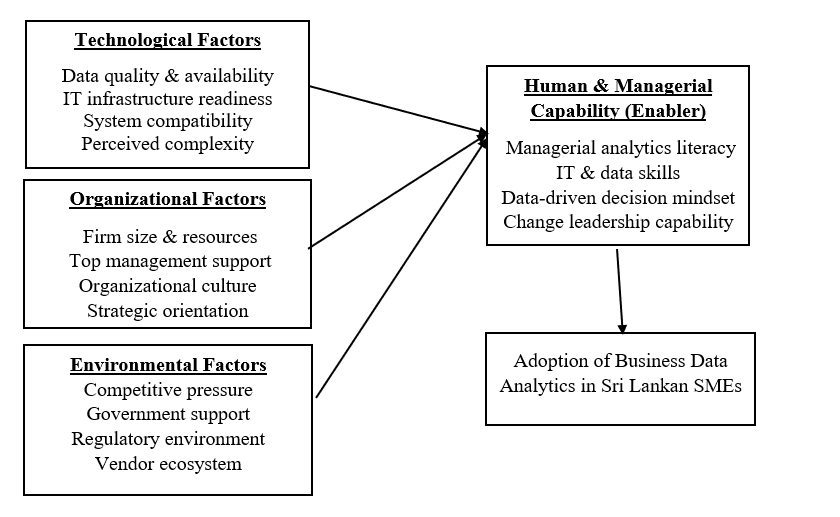
Drawing on TOE as the structural foundation, the adoption of business data analytics (BDA) in SMEs is explained by the suggested conceptual framework as the result of interconnected organizational, technological, environmental, and human capabilities variables. Technological factors such as data availability, system compatibility, and infrastructure preparedness, are the fundamental conditions that determine whether analytics solutions are technically feasible. However, adoption cannot be fueled solely by technological preparedness.
The strategic evaluation and resource allocation of technical potential are influenced by organizational characteristics. Whether analytics is viewed as a priority or as a discretionary investment depends on factors like organizational culture, strategic orientation, and support from top management. Environmental factors, such as the availability of external vendors and support networks, political signals, competitive intensity, and other external pressures and incentives, further influence adoption decisions.
The interpretation and operationalization of technological, organizational, and environmental factors in SMEs is mediated by human and managerial capabilities. Risk perception, resource mobilization, and change preparedness are influenced by managerial analytics literacy, leadership skills, and a data-driven attitude. These skills are especially important for converting internal readiness and external constraints into significant adoption decisions in SME situations with limited resources. The framework as a whole view the adoption of BDAs as a capability-contingent process influenced by interrelated structural and human factors.
2.3.2 Conceptual Framework Diagram
2.3.3 Theoretical Justification of Relationships
The conceptual framework’s suggested links are based on well-established theories of organizational capability and technology adoption. According to the Technology Acceptance Model (TAM) and the technological dimension of the TOE framework, which emphasize perceived utility and ease of use as adoption precursors, technological factors impact the adoption of business data analytics (BDA) through perceived system compatibility, data quality, and infrastructure readiness. The Resource-Based View (RBV), which holds that organizational resources and capabilities determine firms’ ability to adopt and exploit advanced technologies, provides theoretical justification for organizational factors such as top management support, resource availability, and strategic orientation. The environmental context of the TOE framework and institutional theory, which emphasize external legitimacy pressures and structural constraints influencing organizational decision-making, gives environmental factors like vendor ecosystems, competitive pressure, and regulatory support their significance.
Instead of being viewed as an independent driver, human and managerial capability is positioned as an enabling mechanism. According to the dynamic capability hypothesis, leadership skills and management analytics literacy influence how organizational, technological, and environmental factors are perceived and operationalized. Managerial competence links structural determinants to actual BDA adoption in resource-constrained SME environments by determining whether contextual conditions translate into effective adoption decisions.
2.4 Contextualization to Sri Lankan SMEs
2.4.1 Alignment Without Over-Localization
SMEs in Sri Lanka operate under institutional conditions that are typical of many developing countries, such as uneven digital infrastructure, talent gaps, and resource limitations. SME technology adoption is increasingly emphasized in national digitalization plans and policy frameworks, although actual penetration is still unequal (World Bank, 2024). Without incorporating context-specific factors that would restrict generalizability, the suggested framework complies with these requirements.
2.4.2 Conceptual Relevance of Context
The paradigm theoretically recognizes that contextual circumstances affect the prominence and interaction of adoption determinants rather than dictating empirical results. This approach preserves theoretical transferability and analytical rigor while enabling the model to guide future empirical research in Sri Lanka and similar economies.
3. Discussion
This chapter provides the suggested conceptual framework for the adoption of business data analytics (BDA) in Sri Lankan SMEs within the context of current theoretical discussions and real-world applications. The framework’s theoretical contributions are discussed, its practical consequences for important stakeholders are outlined, the limitations of conceptual research are acknowledged, and future empirical study options are suggested. The discussion emphasizes theoretical integration and interpretation above empirical validation, which is in line with the conceptual nature of the study.
3.1 Theoretical Implications
3.1.1 Contribution to Analytics Adoption Theory
Beyond technologically deterministic reasons, this study’s main theoretical contribution is to further analytics adoption theory. Adoption is frequently conceptualized in the analytics literature as a function of data availability or infrastructure preparedness, especially in major enterprises operating in developed economies (Wamba, et al., 2017; Falahat, et al., 2022). By presenting BDA adoption as a capability-contingent and context-sensitive process influenced by the interplay of technological, organizational, environmental, and human factors, the suggested framework challenges this limited perspective.
The approach addresses recent calls for multi-theoretical approaches in analytics research and goes beyond single-theory explanations by combining TOE, DOI, RBV, and TAM (Omrani, et al., 2024). Crucially, the model views managerial and human capacity as an enabling mechanism that influences how structural determinants result in adoption outcomes rather than as an independent predictor. By highlighting interpretation, cognition, and strategic sense-making—dimensions that are frequently under-theorized in analytics research—this improvement expands on the idea of analytics adoption.
By redefining BDA adoption as a dynamic organizational capability-building process rather than a one-time technology decision, the framework also advances theory. This viewpoint is consistent with new research that sees analytics maturity as developing through adaptation and learning rather than rapid adoption (Radicic & Petković, 2023).
3.1.2 Contribution to SME Literature
The study fills a long-standing gap between digital innovation theory and SME realities, which is beneficial from the standpoint of SME research. Although a substantial amount of the literature on SME technology adoption recognizes barriers including low funding, informality, and management centralization, it frequently views SMEs as smaller, scaled-down counterparts of larger corporations (OECD, 2021). By specifically taking into account owner-manager dominance, informal decision structures, and low analytical literacy, the suggested framework questions this presumption.
The framework’s emphasis on management capability is in line with SME-specific research that emphasizes owner-managers’ pivotal role in determining strategic results (Asian Development Bank, 2025). This advances SME theory by supporting the notion that managerial interpretations of value, risk, and feasibility have a greater influence on adoption outcomes than organizational size.
Furthermore, by illustrating how environmental pressures—like institutional support or competitive intensity—do not function consistently across business sizes, the framework expands on the literature on SMEs. A more comprehensive explanation of the diverse adoption patterns among SMEs is provided by filtering their influence through managerial cognition and organizational slack.
3.1.3 Contribution to Developing Economy Research
By addressing the drawbacks of using developed-country technology adoption models without contextual adaptation, the study also significantly advances research on developing economies. Previous research emphasizes how institutional gaps, like lax enforcement of regulations, disjointed digital ecosystems, and a lack of skilled workers, influence how businesses behave in developing nations (Lema, et al., 2021; World Bank, 2021). Nevertheless, a lot of adoption models don’t account for the ways in which these circumstances interact with internal organizational capacities.
By providing a context-sensitive yet transferable model, the suggested framework promotes research on developing economies. The theoretical framework acknowledges structural factors that are typical of emerging economies, such as informality, resource scarcity, and uneven policy assistance, rather than over-localizing to Sri Lanka. According to a report published by United Nations Industrial Development Organization (2023), in response to requests for frameworks that are neither unduly abstract nor strictly national, this strikes a compromise between theoretical generalizability and contextual relevance.
3.2 Practical Implications
3.2.1 Implications for SME Owners/Managers
The framework emphasizes that successful BDA implementation necessitates more than just software or tool purchases for SME owners and managers. Critical enabling variables are leadership commitment, strategic alignment, and managerial analytics literacy. This implies that SMEs ought to give priority to the development of incremental capabilities, such as personnel upskilling, fundamental data governance procedures, and matching analytics projects with pressing business issues.
Additionally, according to the framework, SMEs might profit from tiered adoption strategies that begin with diagnostic and descriptive analytics before moving on to predictive or prescriptive applications. As a report published by OECD (2021) reveals, these phased strategies lower perceived risk and complement the limited financial and human resources of SMEs.
3.2.2 Implications for Policymakers
The results highlight the necessity for policymakers to go beyond infrastructure-led digitalization policies. Although investments in platforms and connectivity are essential, they are insufficient in the absence of additional initiatives aimed at organizational preparedness and managerial skill. Therefore, training programs, consulting services, and analytics literacy initiatives designed especially for SMEs should be incorporated into policy initiatives.
Furthermore, the framework contends that lowering institutional hurdles that deter SMEs from interacting with formal digital ecosystems, such as informality and regulatory ambiguity, is essential to the efficacy of policy (World Bank; International Finance Corporation, 2022). Coordinated digital policies for SMEs that incorporate both capacity-building and financial incentives are probably going to have a greater impact.
3.2.3 Implications for Technology Providers
The framework emphasizes how crucial it is for technology and analytics providers to create solutions that take into account the limitations of SMEs. Analytics platforms that are inexpensive, adaptable, and interoperable with current systems are more likely to be adopted by SMEs. To bridge managerial capability gaps, vendors may also need to offer embedded training, advisory support, and streamlined interfaces.
Providers should highlight useful value creation, usability, and immediate advantages that appeal to SME decision-makers rather than promoting sophisticated analytics (Alghamdi & Agag, 2024).
3.3 Limitations
This study’s main drawback is its conceptual framework. Although the suggested framework is based on current research and well-established theories, it has not undergone empirical testing. As a result, rather than being empirically supported, the correlations expressed should be regarded as theoretically feasible. However, by elucidating concepts, integrating disparate literature, and suggesting verifiable connections for further empirical investigation, conceptual research plays a recognized and significant role in theory formation (Whetten, 1989; Jaakkola, 2020). Conceptually driven frameworks are especially crucial in new research domains where empirical evidence is few or contextually fragmented, such as the adoption of business data analytics among SMEs in developing nations.
An additional constraint pertains to contextual scope. Despite being closely matched to the realities of Sri Lankan SMEs, the framework does not specifically take firm-level variability, regional inequalities, or sector-specific variances into consideration. SMEs differ greatly in terms of organizational maturity, resource endowments, industry characteristics, and managerial skill, all of which may have different effects on the dynamics of technology adoption (Storey, 2016; OECD, 2021). Therefore, the framework is meant to capture common structural, organizational, and environmental variables shared across developing-economy SME contexts rather than providing detailed explanations for individual SME subgroups. This degree of abstraction is in line with conceptual research that seeks to strike a balance between theoretical relevance and contextual sensitivity (Tsang, 2014).
3.4 Future Research Directions
The suggested conceptual framework should be empirically validated in future studies employing mixed-method, quantitative, or qualitative methodologies. While qualitative methods like interviews or case studies could offer deeper insights into managerial sense-making and decision-making processes supporting analytics adoption, survey-based studies using structural equation modeling would allow for systematic testing of the suggested relationships among technological, organizational, environmental, and human capability constructs (Hair, et al., 2022; Creswell & Clark, 2017). Furthermore, conducting cross-country comparative studies in developing countries like Sri Lanka, India, Vietnam, or Indonesia would improve knowledge of how institutional settings and regulatory frameworks influence the adoption of business data analytics, enhancing the framework’s theoretical generalizability and external validity ( GEORGE, et al., 2012). To address the dynamic nature of digital transformation within SMEs, longitudinal study designs would also enable researchers to look at how organizational preparedness and analytics skills change over time. Cross-sectional studies frequently fail to capture learning trajectories, capability accumulation, and adoption sustainability; these approaches are especially useful for doing so (Vial, 2019). Collectively, these potential avenues for future research would help to improve, validate, and expand the suggested framework while furthering empirical research on the adoption of analytics in SME contexts in emerging economies.
4. Conclusion
To address enduring gaps in analytics adoption theory, SME research, and developing-economy scholarship, this conceptual study aimed to create an integrated theoretical framework that would explain the adoption of business data analytics (BDA) among small and medium-sized enterprises (SMEs) in Sri Lanka. Based on well-known theories of technology adoption and organizational capability, including the Technology–Organisation–Environment (TOE) framework, Diffusion of Innovation (DOI), Resource-Based View (RBV), and Technology Acceptance Model (TAM), the study put forth a comprehensive framework that views BDA adoption as a process that is dependent on context and capability rather than being solely a technological decision.
This study is unique since it integrates theory and is sensitive to circumstance. This framework specifically acknowledges the structural realities of SMEs operating in developing economies, such as resource limitations, informal decision-making structures, institutional gaps, and uneven digital ecosystems, in contrast to previous analytics adoption models that are primarily derived from large-firm or developed-economy settings. The framework expands on current theory by highlighting management cognition, analytics literacy, and leadership ability. It does this by highlighting processes of interpretation and sense-making that are frequently under-theorized in analytics research. By exposing the unique dynamics that influence technology adoption in SME contexts and refuting the notion that small businesses adopt technology in a scaled-down manner, the study adds to the body of literature on SMEs.
From a wider angle, the framework emphasizes how crucial analytics adoption is becoming for SMEs’ long-term resilience, competitiveness, and sustainability in increasingly data-driven economies. The capacity to use data to make educated decisions is becoming a strategic requirement rather than an optional improvement for SMEs as they deal with the increasing challenges of digitalization, market instability, and international competition. The study’s conceptual insights support the claim that, rather than relying solely on discrete technology fixes, effective analytics adoption necessitates integrated investments in organizational preparation, managerial capability development, and supporting external contexts.
From a wider angle, the framework emphasizes how crucial analytics adoption is becoming for SMEs’ long-term resilience, competitiveness, and sustainability in increasingly data-driven economies. The capacity to use data to make educated decisions is becoming a strategic requirement rather than an optional improvement for SMEs as they deal with the increasing challenges of digitalization, market instability, and international competition. The study’s conceptual insights support the claim that, rather than relying solely on discrete technology fixes, effective analytics adoption necessitates integrated investments in organizational preparation, managerial capability development, and supporting external contexts.
5. Conflict of Interest Declaration
The author declares that there are no conflicts of interest associated with this study. This research was conducted independently, and no financial, personal, or institutional relationships influenced the conceptual development, analysis, or conclusions of the paper.
6. Funding Statement
This research received no external funding.
7. Abbreviations Used
| Abbreviation | Full Form |
|---|---|
| BDA | Business Data Analytics |
| SME | Small and Medium-sized Enterprise |
| TOE | Technology–Organization–Environment framework |
| DOI | Diffusion of Innovation |
| RBV | Resource-Based View |
| TAM | Technology Acceptance Model |
| OECD | Organisation for Economic Co-operation and Development |
| UNIDO | United Nations Industrial Development Organization |
8. Bibliography
Alsulami , A., Hamid, S. & Ghani, N. A., 2024. Organizational Factors Influencing Data Analytics Adoption in SMEs: A Systematic Review. Journal of Cases on Information Technology, 26(1).
Creswell, J. . W. & Clark, V. L. . P., 2017. Designing and Conducting Mixed Methods Research. 03 ed. s.l.:SAGE Publications, Inc.
Falahat, M. et al., 2022. Big Data Analytics Capability Ecosystem Model for SMEs. Sustainability, 15(1), p. 360.
GEORGE, G., McGahan, A. M. & Prabhu, J., 2012. Innovation for Inclusive Growth: Towards a Theoretical Framework and a Research Agenda. Journal of Management Studies, 49(4), pp. 661-683.
Melo, J. d. & Solleder, J.-M., 2022. Economic Research Forum. [Online]Available at: https://theforum.erf.org.eg/2022/07/05/challenges-digitalisation-mena-sub-saharan-africa/#:~:text=The%20World%20Bank%20(2021)%20attributes,digital%20divide’%20with%20other%20regions. [Accessed 01 January 2026].
Alaskar, T. . H., Alsadi, A. . K., Aloulou, W. J. & Ayadi, F. . M., 2024. Big Data Analytics, Strategic Capabilities, and Innovation Performance: Mediation Approach of Organizational Ambidexterity. Sustainability, 16(12), p. 5111.
Alghamdi, O. & Agag, G., 2024. Competitive advantage: A longitudinal analysis of the roles of data-driven innovation capabilities, marketing agility, and market turbulence. Journal of Retailing and Consumer Services, Volume 76, p. 103547.
Asian Development Bank, 2022. Asian Development Outlook (ADO) 2022 Supplement: Recovery Faces Diverse Challenges, Manila: ADB.
Asian Development Bank, 2025. Harnessing Digital Transformation For Good: Asian Development Policy Report, Manila: Asian Development Bank.
Asiri, A. M., Al-Somali, S. A. & Maghrabi, R. O., 2024. The Integration of Sustainable Technology and Big Data Analytics in Saudi Arabian SMEs: A Path to Improved Business Performance. Sustainability, 11 April, 16(8), p. 3209.
Bianchini, M. & Michalkova, V., 2019. Data Analytics in SMEs: Trends and Policies, Paris: OECD.
Dubey, R., Gunasekaran, A. & Childe, S. . J., 2018. Big data analytics capability in supply chain agility: The moderating effect of organizational flexibility. Management Decisions, 57(3).
Ghodake , S. P. et al., 2024. Enhancing Supply Chain Management Efficiency: A Data-Driven Approach using Predictive Analytics and Machine Learning Algorithms.. International Journal of Advanced Computer Science & Applications, 15(4), p. 672.
Hair, J. F., Ringle, C. M., Sarstedt, M. & Hult, G. T. . M., 2022. A Primer on Partial Least Squares Structural Equation Modeling (PLS-SEM). 03 ed. s.l.:SAGE Publishing.
Herath, H., 2024. FACTORS INFLUENCING THE ADOPTION OF BUSINESS INTELLIGENCE SYSTEMS AMONG SMALL AND MEDIUM-SIZED ENTERPRISES (SMEs) IN THE SRI LANKAN CONTEXT. Journal of Business Studies, 11(2).
Iqbal , R. et al., 2020. Big data analytics: Computational intelligence techniques and application areas. Technological Forecasting and Social Change, April.Volume 153.
Jaakkola, E., 2020. Designing conceptual articles: four approaches. Academy of Marketing Science Review, 10(3).
Jayasekara, B. E. A., Fernando, P. N. D. & Ranjani, R. P. C., 2020. A SYSTEMATIC LITERATURE REVIEW ON BUSINESS FAILURE OF SMALL AND MEDIUM ENTERPRISES (SME). Journal of Management, 15(1), pp. 1-13.
Justy, T. et al., 2023. On the edge of Big Data: Drivers and barriers to data analytics adoption in SMEs. Technovation, Volume 127.
Kgakatsi, M., Galeboe, O. . P., Molelekwa, K. K. & Thango, B. . A., 2024. The Impact of Big Data on SME Performance: A Systematic Review. Businesses, 4(4), pp. 632-695.
Lema, R., Kraemer-Mbula, E. & Rakas, M., 2021. Innovation in developing countries: examining two decades of research. Innovation and Development, 11(2-3), p. 189–210.
OECD, 2021. The Digital Transformation of SMEs, Paris: OECD Publishing.
OECD, 2022. SMEs and entrepreneurship. [Online] Available at: https://www.oecd.org/en/topics/smes-and entrepreneurship.html#:~:text=SMEs%20are%20key%20contributors%20to,potential%20of%20SMEs%20and%20entrepreneurship. [Accessed 15 November 2025].
OECD, 2025. OECD. [Online] Available at: https://www.oecd.org/en/topics/sub-issues/digitalisation-of-smes.html [Accessed 2 January 2026].
Oliveira, T. & Martins, M. . R. O., 2011. Literature Review of Information Technology Adoption Models at Firm Level. Electronic Journal Information Systems Evaluation, 14(1).
Omrani, N. et al., 2024. Drivers of Digital Transformation in SMEs. IEEE Transactions on Engineering Management, Volume 71, pp. 5030-5043.
Pandey, V., Kumar, A. & Gupta, S., 2024. Assessing the need for the adoption of digitalization in Indian small and medium enterprises. Open Engineering, 14(1), p. 20240072.
Radicic, D. & Petković, S., 2023. Impact of digitalization on technological innovations in small and medium-sized enterprises (SMEs). Technological Forecasting and Social Change, 191(12), p. 122474.
Rialti, R., Zollo, L., Ferraris, A. & Alon, I., 2019. Big Data Analytics Capabilities and Performance: Evidence from a Moderated Multi-Mediation model. Technological Forecasting and Social Change, 149(3).
Rogers, E. M., 1982. Diffusion of Innovations. 03 ed. New York: Macmillian Publishing Co., Inc..
Storey, D. J., 2016. Understanding The Small Business Sector. London: Routledge.
The Sunday Times, 2024. SMEs in Sri Lanka: Dearth of entrepreneurial hue, Colombo: The Sunday Times.
Trang, D. T. M., Son, N. . D., Thanh, T. H. & Hung, D. V., 2025. Strategic insights from senior management in implementing digital transformation in Vietnamese SMEs. International Journal of Innovative Research and Scientific Studies, April, 8(2), pp. 3502-3511.
Trisnadewi, A. E., Purnami, S., Amlayasa, B. & Putra, G. . L., 2024. Determinants of Big Data Analytics Adoption by Small and Medium Industries (SMEs) in the Perspective of the Technological-Organizational-Environmental (TOE) Model in Bali. International Journal of Science and Management Studies, 7(5).
Tsang, E. W., 2014. Case studies and generalization in information systems research: A critical realist perspective. The Journal of Strategic Information Systems, 23(2), pp. 174-186.
UNIDO, 2023. Annual Report – 2023: Progress by Innovation, Vienna: United Nations Industrial Development Organization.
Vial, G., 2019. Understanding digital transformation: A review and a research agenda. The Journal of Strategic Information Systems, 28(2), pp. 118-144.
Wamba, S. . F. et al., 2017. Big data analytics and firm performance: Effect of dynamic capabilities. Journal of Business Research, Volume 70, pp. 356-365.
Wang, Y., 2016. What are the biggest obstacles to growth of SMEs in developing countries? An empirical evidence from an enterprise survey. Borsa Istanbul Review, 16(3), pp. 167-176.
Whetten, D. A., 1989. What Constitutes A Theoretical Contribution?. Academy of Management Review, 14(4), pp. 490-495.
World Bank; International Finance Corporation, 2022. Fintech and SME Finance: Expanding Responsible Access, s.l.: World Bank Group.
World Bank, 2021. Data For Better Lives, New Washington: International Bank for Reconstruction and Development.
World Bank, 2025. Small and Medium Enterprises (SMEs) Finance. [Online] Available at: https://www.worldbank.org/en/topic/smefinance [Accessed 19 November 2025].
Если вы собираетесь в поездку в Париж, обязательно загляните на блошиные рынки Парижа — там можно приобрести уникальные вещи и атмосферу старого города. Для фанатов искусства бесплатные музеи Парижа будут прекрасным выбором, а в Лувре обязательно нужно увидеть самым легендарным экспонатам, включая легендарную «Мона Лизу». В центре информации также пригодится карта безопасных районов Парижа и рекомендации по чаевым, например, сколько чаевых оставлять во Франции и как принято действовать в кафе и ресторанах.
Для тех, кто хочет узнать о историей и культурой, предлагаются такие места, как дворец Трокадеро, музей Массена в Ницце и руанский собор. Если намерены попасть до Версаля из Парижа, детальные указания найдете на сайте чаевые во франции . Стоит также увидеть и замки Луары, а также открыть для себя больше о таких легендарных личностях, как Коко Шанель. Обстановка в 15 округе и других округах Парижа — ключевой аспект при планировании прогулок, особенно если вы стремитесь проникнуться с особенной атмосферой Тампль и Сен-Дени.