
Introduction
Marketing and Artificial Intelligence (AI) are increasingly interconnected, reshaping how organizations create, communicate, and deliver value to customers. Marketing, as a discipline, focuses on understanding customer needs and building value-based exchanges, while AI enhances this process through data-driven insights, automation, and predictive intelligence.
Preliminary global insights suggest that AI will have a transformative economic impact in the coming years. It is estimated that AI could contribute up to $13 trillion to the global economy by 2030, potentially increasing global GDP by as much as 16% to 26% (Benerjee, et al., 2023). In addition, according to same research, projections indicate that at least 70% of companies worldwide will integrate AI in some form within the coming years, highlighting the rapid mainstream adoption of this technology.
Within this context, marketing stands out as one of the most significantly affected business functions. AI enables marketers to move beyond traditional approaches toward highly personalized, data-driven, and automated customer engagement systems. As a result, the relationship between marketing and AI is not merely supportive but transformational, redefining how businesses understand and interact with consumers in a digital economy.
Scholarly Definitions
Marketing Definition
The American Marketing Association (AMA) defines marketing as:
“The activity, set of institutions, and processes for creating, communicating, delivering, and exchanging offerings that have value for customers, clients, partners, and society at large.”
Dr. Philip Kotler, widely regarded as the father of modern marketing, defines marketing as:
“A social and managerial process by which individuals and groups obtain what they need and want through creating and exchanging products and value with others.”
Simply, Marketing is the process of understanding customer needs and creating, communicating, and delivering value through products or services, in a way that benefits both customers and organizations through exchange.
Artificial Intelligence (AI) Definition
A widely accepted scholarly definition describes AI as:
“The science and engineering of creating intelligent machines, especially intelligent computer programs that can perform tasks that typically require human intelligence.” (Russell & Norvig, 2021)
Simply, AI is technology that enables machines to think, learn, and make decisions like humans.
1. AI-Driven Personalization in Modern Marketing
Modern marketing has moved far beyond traditional mass communication and broad segmentation. Today, Artificial Intelligence enables true one-to-one marketing, where each customer receives tailored experiences based on continuously updated behavioral and contextual data.
This shift strongly reflects Kotler’s concept of value creation and exchange. In an AI-enabled environment, value is no longer delivered in a standardized way; instead, it is dynamically shaped around individual preferences, intent, and real-time behavior. In other words, AI strengthens Kotler’s “value exchange” by ensuring that what is offered closely matches what each customer is most likely to need or desire at a specific moment.
From a practical standpoint, AI-driven personalization systems integrate and process multiple layers of customer data, including:
- Behavioral data (clicks, browsing time, page depth, abandoned carts)
- Transactional data (purchase frequency, order value, product affinity)
- Contextual data (device type, time of access, location patterns)
- Engagement data (email opens, ad interactions, social media responses)
- Predictive signals generated by machine learning models (likelihood to buy, churn risk, next-best-action)
Unlike traditional analytics, AI does not simply describe past behavior—it continuously learns and updates predictions in real time using techniques such as collaborative filtering, clustering, and deep learning recommendation systems.
According to Salesforce’s State of the Connected Customer Report (2024), 73% of customers expect companies to understand their unique needs and expectations, while 64% of customers expect real-time responses tailored to their actions. This highlights a critical shift: personalization is no longer a competitive advantage—it is becoming a baseline expectation.
Impact of AI-Driven Personalization
AI enables marketers to move from generic targeting to adaptive, behavior-driven engagement across multiple channels:
- Real-time product recommendations (e.g., “customers like you also bought…”) powered by recommendation algorithms
- Dynamic website personalization, where homepage content, offers, and layouts change depending on user profile and intent
- AI-optimized email marketing, where subject lines, send times, and content blocks are personalized for each recipient
- Programmatic ad targeting, where advertising bids and creatives adjust automatically based on user likelihood to convert
From a performance perspective, McKinsey & Company (2023) reports that companies using advanced personalization strategies can achieve revenue uplifts of 10% to 30%, with the strongest gains observed in industries such as retail, media, and financial services. In addition, conversion rates can increase significantly when customers are exposed to highly relevant recommendations rather than generic promotions.
Overall, AI-driven personalization represents a fundamental evolution in marketing: it transforms communication from a one-way broadcast model into a continuously learning, adaptive system that delivers the right message, to the right customer, at the right time.
2. Predictive Analytics: Anticipating Customer Needs
One of the most significant contributions of Artificial Intelligence to modern marketing is its ability to transform decision-making from reactive to predictive. Traditionally, marketers analyzed past customer behavior to evaluate campaign performance. However, AI-powered predictive analytics enables organizations to forecast future customer actions before they occur, allowing businesses to make proactive and highly targeted marketing decisions.
From the perspective of the American Marketing Association (AMA), predictive analytics strengthens the process of “creating, communicating, delivering, and exchanging offerings that have value” by helping firms identify customer needs at the right time and with greater accuracy. Rather than treating all customers equally, AI allows marketers to predict which customers are most likely to purchase, disengage, or generate long-term profitability.
Modern predictive analytics systems use machine learning algorithms to analyze large volumes of customer data, including purchase history, browsing behavior, engagement patterns, transaction frequency, and demographic information. These insights are then used to estimate:
- Customer churn probability (likelihood of leaving a brand)
- Purchase propensity (likelihood of making a purchase)
- Customer Lifetime Value (CLV)
- Product recommendation preferences
- Future spending behavior
A practical example can be seen in e-commerce platforms such as Amazon, where predictive models analyze customer browsing and purchasing histories to recommend products before customers actively search for them. This predictive recommendation approach has become a major driver of customer engagement and repeat purchases.
Customer Lifetime Value (CLV) prediction has become one of the most valuable applications of predictive analytics in marketing. According to Kvíčala et al., (2026), customer behavioral variables such as session duration, source of website visits, transaction frequency, and landing-page interactions significantly influence future customer value. The study found that predictive models can identify high-value customers more accurately, enabling organizations to allocate marketing resources more effectively and maximize long-term profitability.
Similarly, research published by Wong et al., (2025) highlights that machine learning-based CLV prediction models provide more adaptive and scalable forecasts compared to traditional statistical methods. These models help organizations improve segmentation, personalize marketing campaigns, and optimize resource allocation based on predicted future value rather than past spending alone. This aligns directly with the core methodologies outlined in our guide on [how businesses use predictive analysis to stay ahead], which explores the commercial advantages of forward-looking data models.”
Furthermore, contemporary marketing research by Kalinina (2026) indicates that organizations implementing predictive analytics and data-driven attribution models achieve up to 35% higher conversion rates at similar cost levels compared to traditional marketing measurement approaches. This demonstrates how predictive analytics directly contributes to improved marketing performance and customer engagement.
Ultimately, predictive analytics allows businesses to move beyond understanding what customers did in the past and instead focus on what they are likely to do next. This capability enables more personalized customer experiences, higher retention rates, improved conversion performance, and more efficient marketing investment, making predictive analytics one of the most strategically important applications of AI in modern marketing.
3. AI-Powered Customer Engagement
Customer engagement has become one of the most significant areas transformed by Artificial Intelligence. In modern marketing, engagement is no longer limited to responding to customer inquiries; it involves creating continuous, personalized, and meaningful interactions throughout the customer journey. AI-powered technologies such as chatbots, virtual assistants, and conversational agents have enabled organizations to engage customers in real time while maintaining efficiency at scale.
This development closely aligns with Philip Kotler’s concept of marketing as a process of creating and exchanging value. AI systems provide immediate, personalized assistance to customers, while businesses gain valuable behavioral insights that can be used to improve products, services, and customer experiences.
Modern AI chatbots are powered by Natural Language Processing (NLP), Machine Learning (ML), and Large Language Models (LLMs), enabling them to understand context, interpret customer intent, and generate human-like responses. Unlike traditional rule-based chatbots, contemporary AI systems continuously learn from interactions and improve their performance over time.
According to Gartner (2024), 85% of customer service leaders planned to explore or pilot customer-facing generative AI solutions in 2025, demonstrating the rapid integration of AI into customer engagement strategies. Gartner further predicts that by 2028, 70% of customers will begin their customer service journey through conversational AI interfaces, highlighting the growing reliance on AI-powered communication channels.
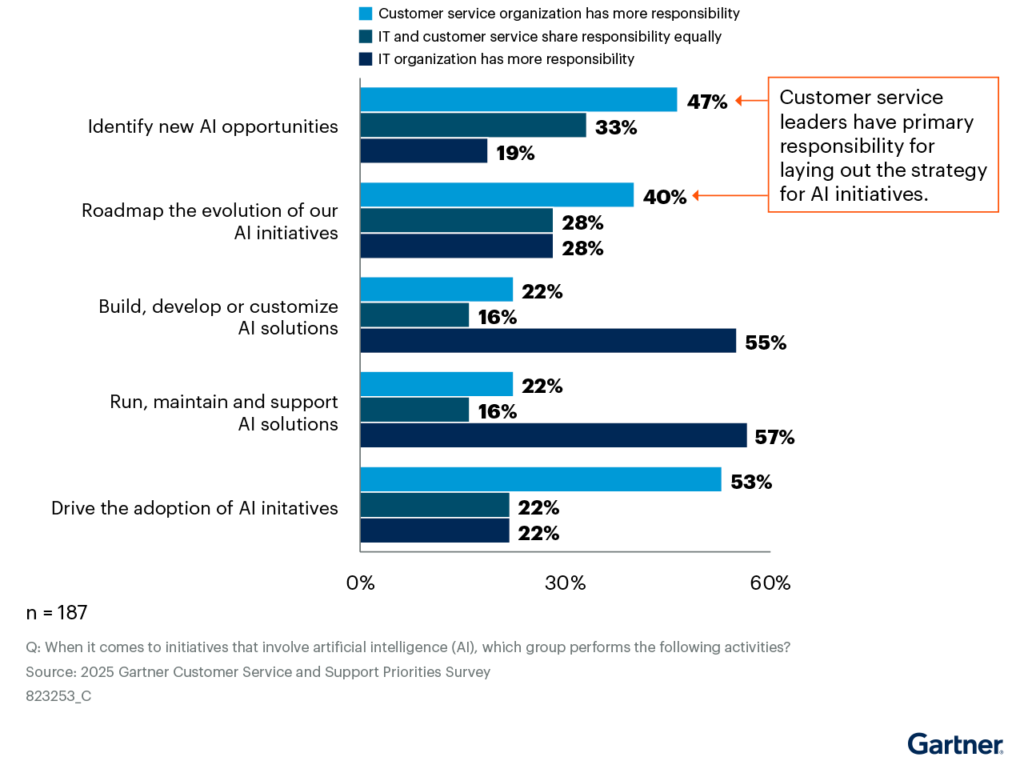
The Gartner Customer Service and Support Priorities Survey (2025) demonstrates that customer service departments are increasingly leading AI transformation initiatives rather than merely adopting technologies developed by IT teams. According to the survey, 53% of respondents indicated that customer service functions are primarily responsible for driving AI adoption initiatives, while 47% reported that customer service leaders take the lead in identifying new AI opportunities. Furthermore, 40% stated that customer service departments are responsible for developing the strategic roadmap for AI implementation. In contrast, IT departments remain primarily responsible for the technical development (55%) and operational maintenance (57%) of AI systems. These findings suggest that AI-powered customer engagement has evolved from a purely technical project into a strategic marketing and customer experience initiative, where customer-facing departments play a central role in shaping AI adoption and value creation.
Furthermore, one of the key advantages of AI-driven customer engagement is its ability to deliver 24/7 support without geographical or time-zone limitations. This capability has become increasingly important as customer expectations continue to rise. Research from Zendesk CX Trends (2024) found that 73% of consumers prefer self-service options for resolving simple issues, indicating a strong preference for fast and convenient support channels.
A practical example can be observed in the retail industry. In 2025, through the U.S newspaper, The Sun; Lowe’s introduced its AI-powered virtual shopping assistant, MyLow, which handles more than one million customer inquiries per month (Evenden, 2026). The company reported that customers who used the AI assistant converted at three times the rate of non-users and showed a measurable increase in customer satisfaction. This demonstrates how AI engagement tools can directly influence purchasing behavior while enhancing customer experience.
AI also significantly improves operational efficiency. Gartner identifies customer personalization, case summarization, and agent assistance as some of the highest-value AI applications in customer service. These capabilities allow businesses to respond more quickly, reduce repetitive workloads, and provide more relevant solutions to customers.
From a financial perspective, AI engagement systems can substantially reduce service costs. Industry research indicates that AI chatbot interactions cost approximately $0.10 per conversation, compared to $6–12 for human-handled interactions. Additionally, AI-assisted customer service systems can achieve first-contact resolution rates of up to 85% for routine inquiries (Stealth Agents, 2026), reducing the need for escalation and improving service speed.
However, the effectiveness of AI-powered engagement depends heavily on implementation quality. Research suggests that customers still value human interaction for complex or emotionally sensitive situations. Consequently, many organizations are adopting a hybrid model where AI handles routine inquiries while human agents manage complex cases. Gartner emphasizes that the most successful AI strategies focus on enhancing—not replacing—human service capabilities.
Overall, AI-powered customer engagement has evolved from a cost-saving tool into a strategic marketing asset. By combining automation, personalization, and real-time responsiveness, AI enables organizations to build stronger customer relationships, improve satisfaction levels, and create more efficient service ecosystems.
4. Marketing Automation and Efficiency
One of the most significant contributions of Artificial Intelligence (AI) to marketing is its ability to automate repetitive and data-intensive tasks while simultaneously improving decision quality. Unlike traditional automation tools that operate based on predefined rules, AI-powered marketing systems continuously learn from customer interactions and optimize campaigns in real time.
AI-driven marketing automation is commonly applied to:
- Personalized email campaigns
- Customer segmentation and targeting
- Social media content scheduling
- Programmatic advertising
- Lead scoring and nurturing
- A/B testing and campaign optimization
The value of AI in marketing automation extends beyond operational efficiency. By analyzing vast amounts of customer data, AI can determine the most effective message, channel, timing, and audience for a campaign. This enables marketers to deliver highly relevant content at scale while reducing manual effort.
For example, AI-powered email marketing platforms can automatically identify the optimal time to send emails to individual customers based on their previous engagement patterns. Similarly, AI-driven lead-scoring systems can rank prospects according to their likelihood of conversion, allowing sales and marketing teams to focus resources on high-potential customers. Research suggests that AI-enabled automation significantly improves campaign performance through better personalization and customer targeting.
A particularly transformative application is programmatic advertising, where AI automates the buying and placement of digital advertisements through real-time bidding systems. Unlike traditional media buying, which relies heavily on human decision-making, programmatic advertising uses machine-to-machine communication to evaluate audience characteristics, predict engagement probability, and purchase ad space within milliseconds. This allows advertisers to optimize advertising spend while reaching the most relevant audiences. Furthermore, Programmatic advertising now accounts for over 90% of digital display ad spending in some markets (eMarketer, 2024).
The strategic impact of AI-driven automation is equally important. Rather than replacing marketers, AI shifts their role from executing routine tasks to focusing on higher-value activities such as strategy development, customer experience design, creativity, and brand management. Recent marketing research indicates that AI is increasingly being adopted as a tool for enhancing productivity, improving campaign optimization, and supporting customer experience management rather than merely reducing labour costs.
Consequently, AI-powered marketing automation represents a shift from manual campaign management to intelligent decision-making, enabling organizations to achieve greater efficiency, personalization, and scalability while maintaining a stronger focus on customer value creation.
5. Generative AI and Content Creation: Enhancing Creativity and Productivity
Generative Artificial Intelligence (GenAI) has emerged as one of the most transformative technologies in modern marketing.
Unlike traditional AI systems that primarily analyze data and identify patterns, generative AI can create original content—including text, images, videos, audio, and code—based on user prompts and learned patterns from large datasets. In marketing, this capability has significantly accelerated content production while enabling greater personalization at scale.
Today, marketers use generative AI across a wide range of content creation activities, including:
- Digital advertisements and campaign copy
- Blog articles and website content
- Social media posts and captions
- Email marketing campaigns
- Product descriptions
- Visual content and marketing graphics
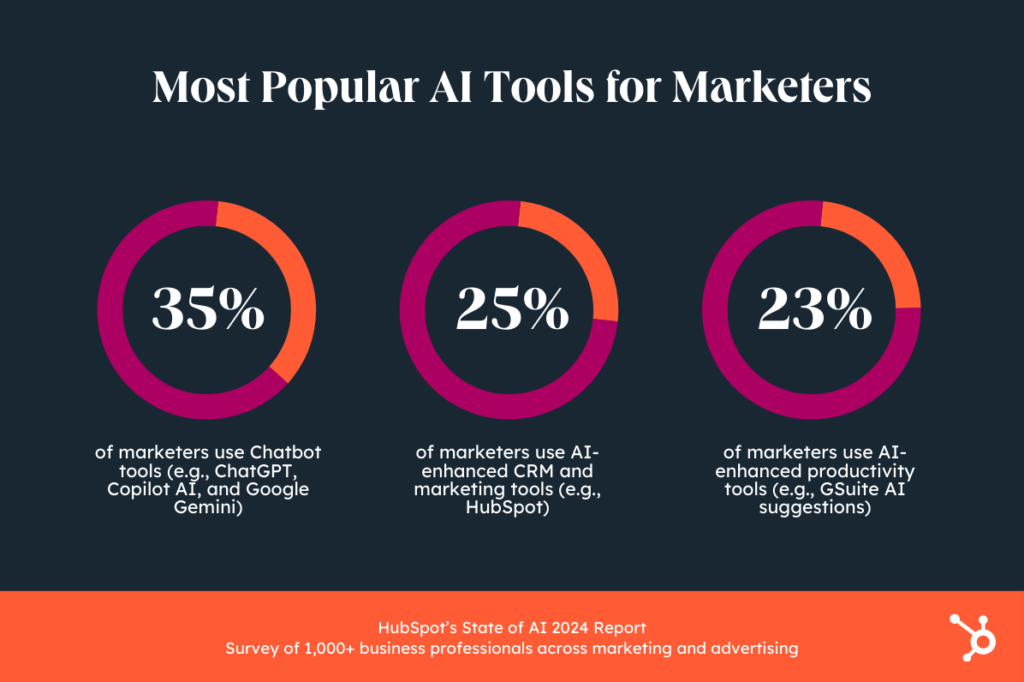
According to HubSpot’s 2024 AI Trends Report, content creation remains the most common marketing application of AI, with 43% of marketers using AI tools specifically to create content. Among these users, 47% employ AI for image generation, 45% for copywriting, and 44% for content quality assurance tasks such as proofreading and optimization. Furthermore, AI-generated emails and newsletters (47%), social media content (46%), and blog posts (38%) rank among the most frequently produced marketing assets.
The strategic value of generative AI extends beyond efficiency. Research published by Grewal, et al., (2025) suggests that generative AI is fundamentally changing how marketers communicate with customers by enabling the rapid creation and delivery of personalized content across multiple channels. This allows organizations to respond more quickly to changing customer preferences and market conditions while maintaining consistent brand communication.
A practical example can be seen in email marketing. Instead of creating a single message for an entire customer base, marketers can use generative AI to produce multiple versions of an email tailored to different customer segments based on demographics, purchasing behavior, and engagement history. This level of personalization would be difficult and time-consuming to achieve through traditional content creation methods.
However, despite its capabilities, generative AI should be viewed as a collaborative tool rather than a replacement for human marketers. HubSpot reports that 86% of marketers who use AI-generated written content edit the output before publication, highlighting the continued importance of human oversight. Similarly, only a small proportion of marketers rely on AI to create complete pieces of content independently; most use it for brainstorming, outlining, drafting, and enhancing existing work.
This reliance on human involvement is essential because effective marketing requires elements that AI cannot fully replicate, including emotional intelligence, cultural awareness, ethical judgment, and authentic storytelling. While AI can generate content quickly, it often struggles to convey unique brand values, lived experiences, and nuanced emotional connections that resonate with audiences. As marketing scholars increasingly argue, the future of content creation lies not in human-versus-AI competition but in human-AI collaboration, where AI enhances productivity while humans provide creativity, strategic direction, and authenticity.
6. AI in Customer Journey Mapping
AI plays a critical role in customer journey mapping by enabling marketers to analyze how individuals interact with a brand across multiple digital and offline touchpoints in real time. Unlike traditional journey mapping—which relies on static assumptions or limited survey data—AI continuously processes large-scale behavioral data to reconstruct actual customer pathways.
This approach strongly aligns with the AMA definition of marketing as a process of “creating, communicating, delivering, and exchanging value,” because AI helps identify exactly where value is enhanced or disrupted across the journey.
Modern AI systems integrate data from:
- Website and app interactions (clickstream data)
- CRM systems
- Email engagement metrics
- Social media behavior
- Paid advertising interactions
- Customer service/chatbot conversations
By combining these datasets, AI builds a unified, real-time view of each customer’s journey rather than isolated channel-specific insights.
Key AI Capabilities in Journey Mapping
1. Drop-off Identification (Funnel Leakage Detection)
AI detects precisely where users abandon the journey—such as product pages, checkout stages, or sign-up forms. For example, research from McKinsey Digital (2023) shows that companies using advanced analytics to optimize digital funnels can reduce abandonment rates by 10–20% by identifying friction points such as slow page load times or complex checkout processes.
2. Conversion Path Optimization
Machine learning models analyze thousands of behavioral sequences to determine which customer paths are most likely to result in conversion. This moves marketing from intuition-based decisions to probability-driven targeting. A study published by Alonge, et al., (2025) found that predictive journey modeling can improve conversion rates by 15–35% by prioritizing high-probability user pathways.
3. Channel Performance Attribution
AI uses multi-touch attribution models to determine how each channel contributes to conversion, replacing outdated “last-click” attribution models. According to research by Gautam (2024), data-driven attribution models can improve marketing ROI by up to 30% by reallocating budgets to high-impact channels such as search and retargeting instead of low-performing display ads.
Personalization at Journey Level
AI does not only map journeys—it adapts them in real time for individual users. For example:
- A returning customer may see faster checkout flows
- A first-time visitor may receive educational content before product offers
- A high-intent shopper may be retargeted with dynamic pricing or urgency messaging
According to Salesforce (2024), 73% of customers expect companies to understand their unique needs, and journey-level personalization is a key driver of this expectation.
Evidence of Impact
Organizations using AI-driven journey mapping report significant performance improvements. IBM Institute for Business Value (2023) found that companies applying AI to customer experience and journey analytics achieved:
- Up to 50% improvement in conversion efficiency
- Significant reductions in customer churn through early intervention
- Higher customer satisfaction due to reduced friction across touchpoints
These gains occur because AI enables marketers to shift from broad segmentation to individual-level journey optimization, ensuring that value is delivered consistently at every stage of the customer lifecycle.
7. Ethical Challenges in AI Marketing
Despite its clear advantages in improving efficiency and personalization, Artificial Intelligence in marketing raises several serious ethical concerns that directly affect consumer trust, brand reputation, and long-term business sustainability.
Data Privacy and Consumer Surveillance
AI-driven marketing systems depend heavily on large-scale data collection, including browsing behavior, purchase history, location data, and even cross-device tracking. While this enables personalization, it also raises significant privacy concerns.
A study by Pew Research Center (2023) found that 79% of consumers are concerned about how companies use their personal data, and more than half feel they have little or no control over it.
This creates a direct tension between AI-powered personalization and consumer privacy expectations. From a marketing perspective, this challenges the AMA principle of delivering “value for society at large,” because misuse or over-collection of data can reduce trust and perceived value.
Algorithmic Bias and Discrimination
AI systems learn from historical data, which may contain embedded social, cultural, or economic biases. As a result, AI-driven marketing tools can unintentionally reinforce discrimination in targeting, pricing, or content delivery.
For example, a well-documented case in academic research by Noble (2018) highlighted how algorithmic systems can produce biased search and recommendation outputs that disproportionately disadvantage certain demographic groups.
Similarly, a study published in Chandra, et al., (2023) emphasized that biased training data can lead to unequal ad delivery, where certain groups are less likely to receive opportunities such as job or housing advertisements. These infrastructure and data limitations are a key hurdle when localized; as discussed in our [framework for the adoption of business data analytics in Sri Lankan SMEs], smaller enterprises face unique data constraints that require careful structural planning.”
This contradicts ethical marketing principles by undermining fairness in value exchange.
Lack of Transparency (“Black Box” Decision-Making)
Many AI marketing systems operate as “black boxes,” meaning their decision-making processes are not easily interpretable by humans. Marketers may know what outcome the AI produces but not why it made that decision.
According to the research by Balasubramaniam, et al., (2023), lack of explainability in AI systems is one of the biggest barriers to trust and adoption in business environments.
This creates ethical concerns in marketing contexts such as:
- Why a customer was targeted with a specific ad
- Why certain users received different pricing or offers
- How recommendations are prioritized
From a Kotlerian perspective of transparent value exchange, this opacity can weaken customer trust in the marketing process.
Over-Personalization and Consumer Manipulation
While personalization improves engagement, excessive use of AI can lead to “hyper-targeting,” where consumers feel monitored or influenced beyond their comfort level.
Research by Petrova (2025) shows that overly personalized advertising can create a “creepiness effect,” where consumers feel their privacy boundaries are violated, leading to reduced brand trust and lower purchase intention.
For example, when users see ads that reflect very recent private conversations or browsing behavior, it may enhance relevance but also increase discomfort.
This highlights a key ethical boundary: effective marketing should inform and assist consumers, not manipulate or excessively predict their behavior.
8. Future of Marketing with AI
The future of marketing is moving toward a hybrid intelligence model, where artificial intelligence handles large-scale data processing, automation, and prediction, while human marketers focus on creativity, ethical judgment, brand storytelling, and strategic decision-making. This shift is not theoretical—it is already visible in current enterprise adoption patterns.
A McKinsey analysis shows that marketing and sales is one of the business functions with the highest potential value impact from generative AI, estimated at $0.9 to $1.3 trillion annually across industries (McKinsey, 2023). This scale of impact indicates that AI is no longer a support tool but a core driver of marketing transformation.
Fully Autonomous Marketing Systems
Marketing systems are rapidly evolving toward partial autonomy, where AI can independently manage campaign execution, optimization, and budget allocation. For example, Google’s Performance Max campaigns use machine learning to automatically optimize ads across channels in real time.
Research by Deloitte (2025) suggests that organizations using advanced AI-driven automation in marketing report up to 20–30% improvement in marketing ROI due to reduced manual intervention and faster optimization cycles.
However, full autonomy is still limited because strategic oversight, ethical compliance, and brand positioning require human judgment—elements that align with Kotler’s view of marketing as a value-driven social process, not just a technical optimization function.
Emotion-Aware and Generative AI in Customer Experience
A growing frontier in AI marketing is emotion-aware AI, which uses sentiment analysis, facial recognition (in controlled environments), and behavioral signals to understand customer emotional states.
According to a 2023 IBM Institute for Business Value report, over 60% of consumers expect personalized and emotionally relevant experiences, but only about 35% of companies consistently deliver them—creating a significant “experience gap” that AI is expected to close.
This evolution extends the AMA definition of marketing—“creating and delivering value”—by making “value” not only functional but also emotional and experiential.
Voice and Visual Search Optimization
Consumer behavior is also shifting toward voice and visual search, driven by AI assistants and mobile-first usage.
- Google reports that 27% of the global online population uses voice search on mobile devices (Nash, 2026).
- Visual search adoption is growing in e-commerce, with platforms like Pinterest Lens enabling product discovery through images rather than text.
This trend is particularly important for marketing strategy because it changes SEO from keyword-based optimization to intent-based and multimodal discovery systems. Brands that fail to adapt risk losing visibility in AI-mediated search ecosystems.
Real-Time Adaptive Advertising
One of the most significant developments in AI marketing is real-time adaptive advertising, where ad content, timing, and placement are dynamically adjusted based on user behavior.
Programmatic advertising systems already account for over 90% of digital display ad spending in leading markets (Yuen, 2023), and AI is enhancing these systems further through real-time bidding and contextual optimization.
According to McKinsey (2023), companies that use AI-driven personalization in marketing can achieve 10–15% revenue uplift and 10–20% cost efficiency improvements, demonstrating the measurable business impact of adaptive advertising systems.
Strategic Human Role in the AI Era
Despite automation, human marketers will remain central to:
- Brand identity development
- Ethical decision-making and data governance
- Creative storytelling and emotional branding
- Long-term strategic positioning
This aligns with Philip Kotler’s argument that marketing is fundamentally a social and managerial process, meaning it cannot be fully reduced to algorithms. AI can optimize decisions, but it cannot define cultural meaning or brand authenticity.
Outlook Toward 2030
By 2030, AI is expected to dominate operational marketing tasks such as media buying, segmentation, testing, and content optimization. However, rather than replacing marketers, it will redefine their roles into strategic “AI supervisors and creative architects.”
Gartner (2024) predicts that at least 80% of marketing tasks will be partially automated by 2030, but human oversight will remain essential for trust, compliance, and brand differentiation.
Conclusion
Marketing, as defined by both the AMA and Philip Kotler, is fundamentally about creating and delivering value through exchange. Artificial Intelligence enhances this process by enabling precision, prediction, and personalization at scale. AI—defined as systems capable of simulating human intelligence—has become a transformative force in marketing, reshaping customer engagement, automation, and decision-making. However, the future success of AI in marketing depends on balancing technological capability with ethical responsibility and human creativity. Ultimately, the integration of marketing and AI represents not the replacement of human marketers, but the evolution of marketing into a more intelligent, responsive, and customer-centric discipline.
If you enjoyed this post, let’s stay connected!
Connect with us on Linkedin for professional discussions and industry updates.
Follow us on Instagram for business tips, behind-the-scenes content, and inspiration.
Follow us on Twitter for the latest industry news, quick insights, trending discussions, and real-time updates.
Follow us on Facebook for in-depth discussions, articles, and updates.
We’d love to hear your thoughts, feedback, or experiences in the comments. Let’s keep the conversation going!