

In boardrooms around the world, a familiar conversation plays out every quarter. Digital transformation is acknowledged as important, budgets are discussed, timelines are pushed back, and the status quo continues.

For many organisations, this pattern feels like prudent caution. In reality, it is one of the most expensive decisions a business can make — because delay itself carries a price, and that price compounds quietly until it cannot be ignored.
The Scale of What Is at Stake
To understand the cost of delay, it helps to first appreciate the scale of the transformation underway. According to the Statista Research Department; global digital transformation spending reached $2.5 trillion in 2024 and is forecast to reach $3.9 trillion by 2027, reflecting a five-year compound annual growth rate of 16.2% from 2022 to 2027. These are not discretionary investments — they represent the pace at which competitors, customers, and entire industries are moving.
Yet despite this investment, the reality is sobering. As Donal Tobin through his research published in 2026 reveals that while 89% of large companies globally have a digital and AI transformation journey underway, they have captured only 31% of expected revenue lift and 25% of expected cost savings. This means that even organisations actively pursuing transformation are not fully realising its value. For organisations that delay entirely, the gap widens every year.
The Compounding Cost of Legacy Systems
The most immediate financial consequence of delayed transformation is the burden of legacy technology. Organisations that defer modernisation do not avoid costs — they simply trade future investment for mounting present expense.
According to Deloitte’s 2024 MarginPLUS survey of nearly 300 business leaders, 82% reported their companies had missed cost reduction targets. The number of respondents who named challenges with technology infrastructure as a barrier to success rose from 31% in the previous edition to 50% in 2024.
British Business Excellence Awards reveals that up to 70% of technology leaders view technical debt as the primary cause of productivity loss. Software developers alone spend an estimated 33% of their time dealing with legacy system maintenance rather than building new capabilities. Furthermore, as many as 78% of developers reported that spending too much time on legacy systems had a negative impact on morale, with employee and customer churn and lost deals cited as further consequences.
The financial arithmetic is stark. According to IT Brew, organisations typically allocate 60 to 80% of IT budgets to simply maintaining legacy systems, leaving only a fraction for innovation. In the United States alone, the estimated cost of technical debt grew to $1.5 trillion in 2022, despite chief information officers spending 10 to 20% of their budgets on resolving issues related to outdated systems.
The Security Risk of Inaction
Beyond operational costs, delayed digital transformation creates escalating cybersecurity exposure. Older systems were not built to defend against modern threats, and the gap widens every year they remain in use.
The IBM 2024 Cost of a Data Breach Report found that the average cost of a data breach is $4.88 million, a figure that continues to grow year on year. Legacy systems are disproportionately vulnerable. According to a 2021 Gartner forecast, more than 85% of organisations would embrace a cloud-first principle by 2025 and would not be able to fully execute their digital strategies without cloud-native architectures and technologies. With 2025 now behind us, this prediction underscores a critical reality: organisations that delayed cloud adoption and continued relying on legacy infrastructure have found themselves structurally unable to move at the speed their digital strategies require.
For enterprises running 10 to 15 legacy applications, direct maintenance alone costs between $400,000 and $800,000 annually — before talent premiums, productivity loss, or risk exposure are factored in. Industry benchmarks consistently place legacy maintenance at 60 to 80% of total IT spend across enterprise portfolios as revealed in a research by Keerthi Murali. This is not a cost of transformation. It is the cost of avoiding it.
What History Teaches: The Case of Kodak and Blockbuster
The most instructive lessons come not from abstract statistics but from real companies that faced a choice between transformation and delay — and chose delay.
Kodak is perhaps the most studied example. According to Mooncamp; despite holding approximately 70% of the global film market, Kodak’s internal resistance to change and heavy dependence on legacy products made it impossible to adapt when digital photography emerged. The company actually invented the digital camera but feared it would cannibalize its film business. Competitors such as Canon and Sony, which took flexible and responsive approaches to emerging technology, captured material market share in digital photography while Kodak fell behind. Kodak filed for bankruptcy in 2012.
Blockbuster follows the same pattern. Blockbuster had opportunities to acquire Netflix and was aware of changing consumer behaviour and emerging subscription models. It did not lack intelligence or data — it lacked the conviction to disrupt its own business model built on physical stores, late fees, and DVDs. Instead of acting boldly, it stayed comfortable, and comfort proved fatal during disruption.
Both cases illustrate a critical point: the cost of delay is rarely visible on a balance sheet until it is too late. The erosion of competitive position happens gradually, then suddenly.
The SME Vulnerability
The hidden costs of delayed transformation are not limited to large enterprises. Small and medium-sized enterprises face compounding pressures of their own.
The World Economic Forum (WEP) notes that SMEs contribute up to 70% to employment and GDP globally, yet 67% of SMEs and mid-sized businesses are currently fighting for survival. The absence of technological adoption has been a significant factor, with approximately 25% of SMEs citing the inability to keep up with technology and innovation demands as a top challenge.
In the United States specifically, WEP reveals that SME contribution to GDP has fallen nearly 5%, from 48.0% to 43.5% between 1990 and 2014, a decline in which limited technology adoption played a significant role. The organisations that invested in digital capabilities during this period gained productivity, market access, and resilience. Those that delayed lost ground they have not recovered. These structural adoption hurdles are not unique to Western markets; as detailed in our [framework for the adoption of business data analytics in Sri Lankan SMEs], smaller enterprises globally face localized resource and infrastructure constraints that require targeted, scalable solutions.
The Competitive Divergence Is Already Happening
Perhaps the most consequential hidden cost of delay is the growing performance gap between digital leaders and digital laggards. This gap is not theoretical — it is measurable and growing.
Companies with strong digital and AI capabilities earn two to six times higher shareholder returns than those that fall behind, across every sector studied, according to McKinsey & Company. Digital transformation focused on customer experience can lead to a 20 to 30% increase in customer satisfaction and generate 20 to 50% economic gains.
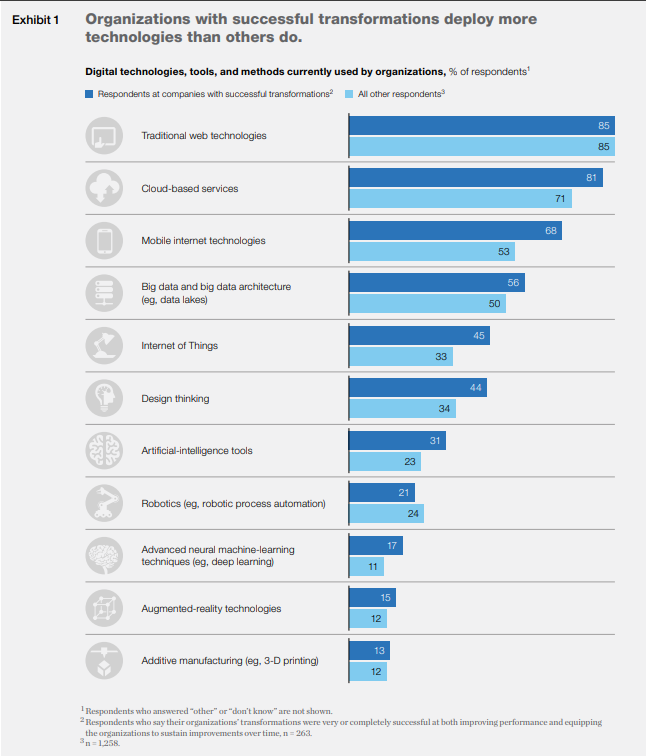
Figure 02: Technology deployment rates of successful digital transformations versus peers (Source: McKinsey & Company).
Delaying digital transformation creates a widening performance gap where digital leaders secure two to six times higher shareholder returns by deploying advanced ecosystems rather than just basic web tools. As illustrated in figure 02, successful organizations aggressively outpace laggards in adopting cloud services (81% vs. 71%), mobile tech (68% vs. 53%), big data (56% vs. 50%), and AI (31% vs. 23%). By failing to scale these capabilities, hesitating companies permanently lose customer loyalty to agile competitors who are actively meeting the modern demand for personalization.
As further revealed by McKinsey & Company, the customer side of this equation is equally clear. In today’s digital environment, 73% of consumers expect improved personalisation as a company’s technology advances, and 40% of consumers will visit a competitor’s website instead when they cannot access a company’s mobile site properly. Every month an organisation delays improving its digital customer experience is a month its competitors use to build loyalty it cannot recapture. A practical example of an enterprise proactively leaning into this shift to capture mobile-first consumers can be found in our [case study on e-commerce and delivery app adoption at Cargills Food City].
Why Organisations Still Delay
Understanding the cost of delay is one thing. Understanding why organisations delay despite that knowledge is another. Research by Statista Research Department indicates that the primary barriers to digital transformation include the complexity of the current environment (32%), lack of technical expertise (27%), and high upfront costs.
There is also a deeper psychological barrier. As the Kodak and Blockbuster cases demonstrate, organisations frequently resist transformation not because they are unaware of the need, but because transformation requires disrupting what is currently working. As revealed in BCG Matrix only 16% of organisations report that their digital transformations have successfully improved performance and equipped them to sustain changes over the long term. This low success rate makes caution feel rational, even as inaction accelerates the very decline organisations are trying to avoid.
It is worth acknowledging that the cost pressure runs in both directions. According to IBM’s Institute for Business Value, the average cost of computing is expected to climb 89% between 2023 and 2025, with 70% of executives citing generative AI as a critical driver of this increase — and every executive surveyed reporting the cancellation or postponement of at least one AI initiative due to cost concerns. Even OpenAI, the company driving much of the AI revolution, raised $6.6 billion in October 2024 to manage its own escalating operational costs. The lesson here is not that transformation should be avoided, but that it must be approached strategically — with clear priorities, phased investment, and measurable milestones rather than all-or-nothing commitments.
The Way Forward
The evidence points to a clear conclusion: the question for businesses is not whether to transform, but how to begin. The World Economic Forum’s 2024 white paper on SME digital transformation offers a step-by-step approach for organisations to overcome barriers and harness new technologies to enhance efficiency and unlock new revenue streams, emphasising that even incremental progress generates compounding competitive advantage over time.
Transformation does not require replacing everything at once. It requires beginning — identifying the highest-cost legacy systems, the highest-value customer experiences, and the most critical operational bottlenecks, and addressing them in sequence. Every month of delay makes the eventual transition harder, more expensive, and more disruptive.
The hidden cost of delay is not a line item. It is the sum of every efficiency unrealised, every customer lost, every competitor gain, and every security risk left unaddressed. It grows silently — until it does not.
Enjoyed this article?
Stay connected for more insights on business strategy, marketing, innovation, and digital transformation.
Have a perspective to share? We’d love to hear your thoughts in the comments.